Gate Leveraged ETF: How to Amplify Trading Efficiency in Highly Volatile Markets
Rapid Market Shifts Demand Upgraded Investment Logic
As the crypto market matures, price action has accelerated, leaving investors with little time for deliberation. Sudden rallies and swift corrections often play out within hours, sharply reducing the time available for decision-making and execution. In this environment, relying solely on long-term holding strategies is no longer sufficient to keep pace with high-frequency volatility. Increasingly, traders are seeking tools that can quickly translate market analysis into actionable positions, moving beyond basic directional calls.
Spot and Futures Trading Need a Transitional Layer
Spot trading is straightforward, secure, and features simple risk structures, but capital efficiency is limited when trends are clear. Futures trading amplifies gains from volatility but introduces leverage, margin management, and forced liquidation risks. Many traders are caught between these options: they want greater capital efficiency but are reluctant to take on the operational complexity and psychological stress of futures. This is precisely why leveraged ETF products exist.
Gate Leveraged ETF Tokens: System-Managed Complexity
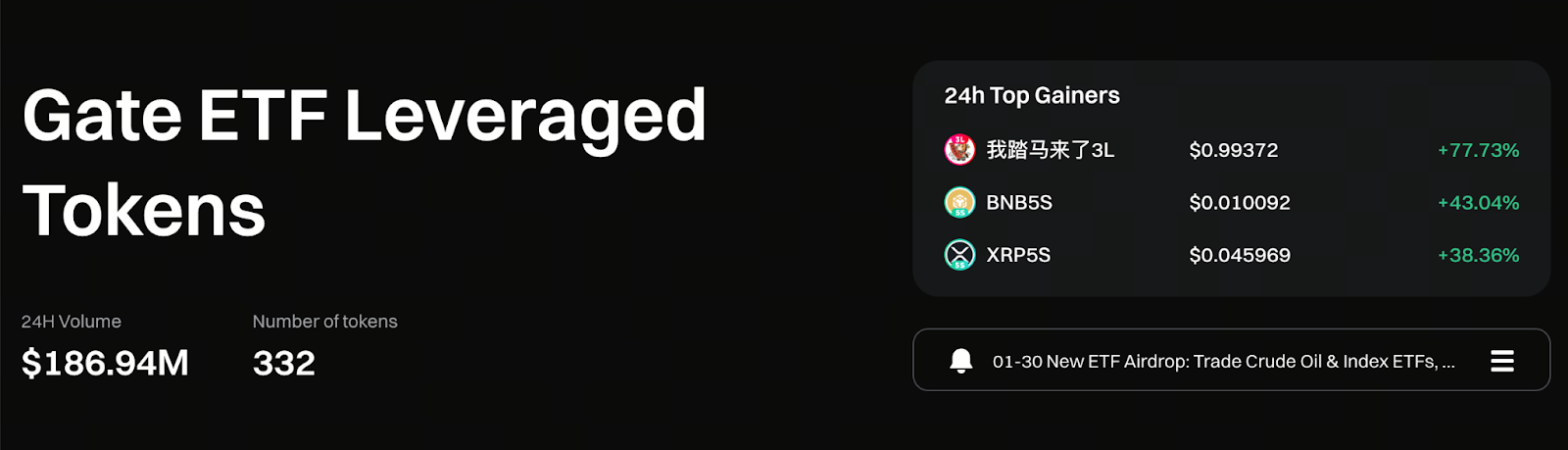
Gate’s leveraged ETF tokens are powered by perpetual contracts for leveraged exposure, but all leverage adjustments, position management, and risk controls are fully automated by the system. For users, trading logic is nearly identical to spot: simply buy or sell the token to gain amplified market exposure.
Users never need to manage:
- Leverage settings
- Margin levels
- Liquidation risks
- Funding rate calculations
Leverage is built into the product itself, so strategy execution feels familiar to most traders.
Trade Gate leveraged ETF tokens now: https://www.gate.com/leveraged-etf
Rebalancing Mechanism Prevents Runaway Risk
Unlike traditional one-off leverage, Gate’s leveraged ETFs use a rebalancing system that automatically adjusts underlying positions based on market volatility, keeping exposure within the intended leverage range. The main goal is not to boost returns, but to prevent leverage from spiraling due to one-sided moves—keeping risk predictable. This also means that performance depends on the price path, not just the difference between start and end prices.
No Forced Liquidation—Strategies Run to Completion
In futures trading, short-term adverse moves can instantly terminate a strategy. With leveraged ETFs, market swings only affect net asset value—there’s no forced exit at a specific price.
This allows traders to focus on:
- Whether the market direction remains valid
- Whether the original strategy needs adjustment
Instead of worrying about liquidation or unexpected forced exits disrupting their plans.
Amplification Works Best in Trending Markets
In strong, clear trends, leveraged ETFs can magnify price movements’ impact on capital without added operational complexity. Rebalancing in trending markets can create a compounding, rolling effect.
As a result, these products are most often used as:
- A transitional tool between spot and futures
- A testing ground for short- or medium-term trend strategies
- An auxiliary option for boosting capital efficiency
Rather than as speculative vehicles chasing maximum leverage.
In Sideways Markets, Structure Can Be a Double-Edged Sword
During extended sideways trading, rebalancing may gradually erode net asset value, leading to outcomes that diverge from expectations.
Key factors affecting performance include:
- Volatility frequency
- Price movement path
- Transaction costs during adjustments
This is why leveraged ETFs are generally unsuitable for long-term passive holding, and work best with clear entry and exit strategies.
Management Fees Are the Cost of Proper Structure
Gate leveraged ETFs charge a daily management fee of about 0.1%, supporting the product’s operation—including contract adjustments, funding rates, and rebalancing costs. This is a transparent, structural cost that ensures the product maintains its leverage target.
Who Should Use Gate Leveraged ETFs?
In practice, these products suit:
- Traders with clear market views
- Those with basic risk management and entry/exit plans
- Users seeking higher capital efficiency without futures
- Users comfortable with short-term net value fluctuations
The key prerequisite: understanding that product structure is integral to risk management.
Conclusion
Gate leveraged ETFs are not about promising higher returns—they enable traders to quickly turn market analysis into real positions, without entering the futures system, while still participating in fast-paced markets. For those who understand risk management, they’re not a replacement for spot or futures, but an efficiency tool bridging both. The real question is not about leverage itself, but knowing when to use it—and when to avoid it.
Related Articles

AI-Native Settlement Layers: How United Stables Is Building the Next Financial Rail

The ve(3,3) Flywheel Explained: How AERO Tokenomics Powers Aerodrome’s DeFi Economy

How Does PAXG Work? In-Depth Overview of the Physical Gold Tokenization Mechanism

Aerodrome Tokenomics: How ve(3,3) Powers Base's Most Profitable DEX

How is the price of PAXG determined? Pegging mechanism, trading depth, and influencing factors
