Gate Leveraged ETF: A Third Option Between Spot and Futures Trading
As Market Dynamics Accelerate, Trading Tools Must Keep Pace
The crypto market has undergone a fundamental shift in recent years. Volatility is up, but more importantly, the pace has quickened across the board. Price action cycles—from consolidation and breakout to retracement—now often complete within a single day. In this environment, investment performance depends not just on accurate analysis, but on timely entry. Frequently, the strategy is sound, but execution speed lags behind the market.
The Vacuum Between Spot and Futures
For most traders, spot and futures each come with distinct limitations:
- Spot trading is simple, but capital efficiency is limited
- Futures are efficient, but require managing leverage, margin, and liquidation risk
Many participants find themselves caught in the middle: wanting to boost capital efficiency without facing the pressure and complexity of the futures market. This has fueled growing interest in products that bridge the gap between spot and futures.
Gate Leveraged ETF: Leverage Encapsulated in Spot Format
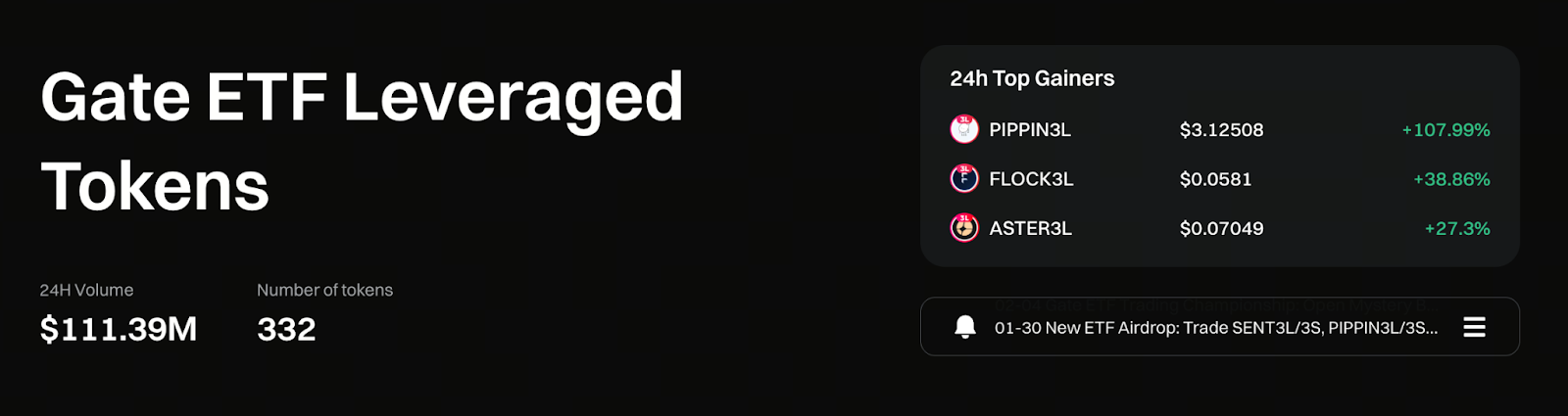
Gate Leveraged ETF is built on the logic of perpetual futures, but all leverage-related mechanics are handled automatically by the system.
For users, the experience feels much like spot trading:
- Simply buy or sell the corresponding token
- No need to set leverage multiples
- No margin management required
- No exposure to liquidation triggers
Leverage is integrated within the product structure. Users only need to decide on direction and place their order.
Trade Gate Leveraged ETF now: https://www.gate.com/leveraged-etf
Rebalancing: Managing Structural Risk, Not Chasing Extremes
Unlike one-off high leverage, Gate Leveraged ETF employs a dynamic rebalancing mechanism. The system automatically adjusts underlying positions based on market volatility, keeping overall exposure near the target multiple. This design prioritizes preventing uncontrolled leverage rather than maximizing returns. The trade-off: performance is influenced by the price path. Actual results depend not just on the start and end points, but also on the volatility along the way.
No Liquidation Line—Strategies Aren’t Forced to Stop
In futures trading, strategies can be forcibly liquidated by short-term adverse moves, even when fundamentally sound. With leveraged ETFs, there’s no forced liquidation price. Market volatility only impacts net asset value, and the system never triggers an automatic exit at a specific level.
This lets traders focus on what truly matters:
- Is the market trend still valid?
- Does the strategy need adjustment?
Instead of watching liquidation lines every day.
Leveraged ETFs Shine in Trending Markets
When markets trend or move decisively, leveraged ETFs amplify price movements’ impact on capital—without adding operational complexity.
These products are best suited for:
- Medium- and short-term trend strategies
- Maximizing capital efficiency for single directional calls
- Serving as a transition tool between spot and futures
Not for passive, long-term holding without a strategy.
Sideways Markets: Structure Can Become a Liability
In prolonged sideways markets, the rebalancing mechanism can gradually erode net asset value, leading to outcomes below intuitive expectations.
Key factors include:
- Frequency of price swings
- Magnitude of each fluctuation
- Transaction costs during adjustments
This is why leveraged ETFs are best viewed as strategic tools, not simple long-term investment vehicles.
The Purpose of Management Fees
Gate Leveraged ETF charges a daily management fee of approximately 0.1%. This fee covers underlying contract adjustments, funding rates, and the rebalancing mechanism. It’s not a hidden cost, but an essential element for stable, long-term operation of the leveraged structure.
Who Should Consider Leveraged ETFs?
Practically speaking, leveraged ETFs are most suitable for:
- Users with basic market judgment
- Those with clear entry and exit strategies
- Those seeking higher capital efficiency without trading futures
- Those who can accept short-term net asset value fluctuations
The key prerequisite: understanding the product structure is integral to risk management.
Summary
The core value of Gate Leveraged ETF isn’t about promising higher returns. It’s about closing the gap between market insight and timely entry. It empowers traders to participate in high-velocity markets without entering the futures system, offers greater capital efficiency than spot, and avoids common liquidation risks seen in futures. What matters most isn’t the leverage multiple—it’s knowing:
When this tool fits the situation, and when it doesn’t.
Related Articles

AI-Native Settlement Layers: How United Stables Is Building the Next Financial Rail

The ve(3,3) Flywheel Explained: How AERO Tokenomics Powers Aerodrome’s DeFi Economy

How Does PAXG Work? In-Depth Overview of the Physical Gold Tokenization Mechanism

Aerodrome Tokenomics: How ve(3,3) Powers Base's Most Profitable DEX

How is the price of PAXG determined? Pegging mechanism, trading depth, and influencing factors
