Gate Introduces CRO Staking as a New Savings Option: Earn 6.22% APY with Rational Participation in Cronos On-Chain Yields

2026-01-09 01:41:22
Beginner
Quick Reads
Gate Earn has recently introduced a CRO staking product, featuring a current reference annualized yield of 6.22%. This provides CRO holders with a financial solution to participate in the Cronos network and earn on-chain returns.

What Is CRO Staking? How Gate Wealth Management Streamlines Participation
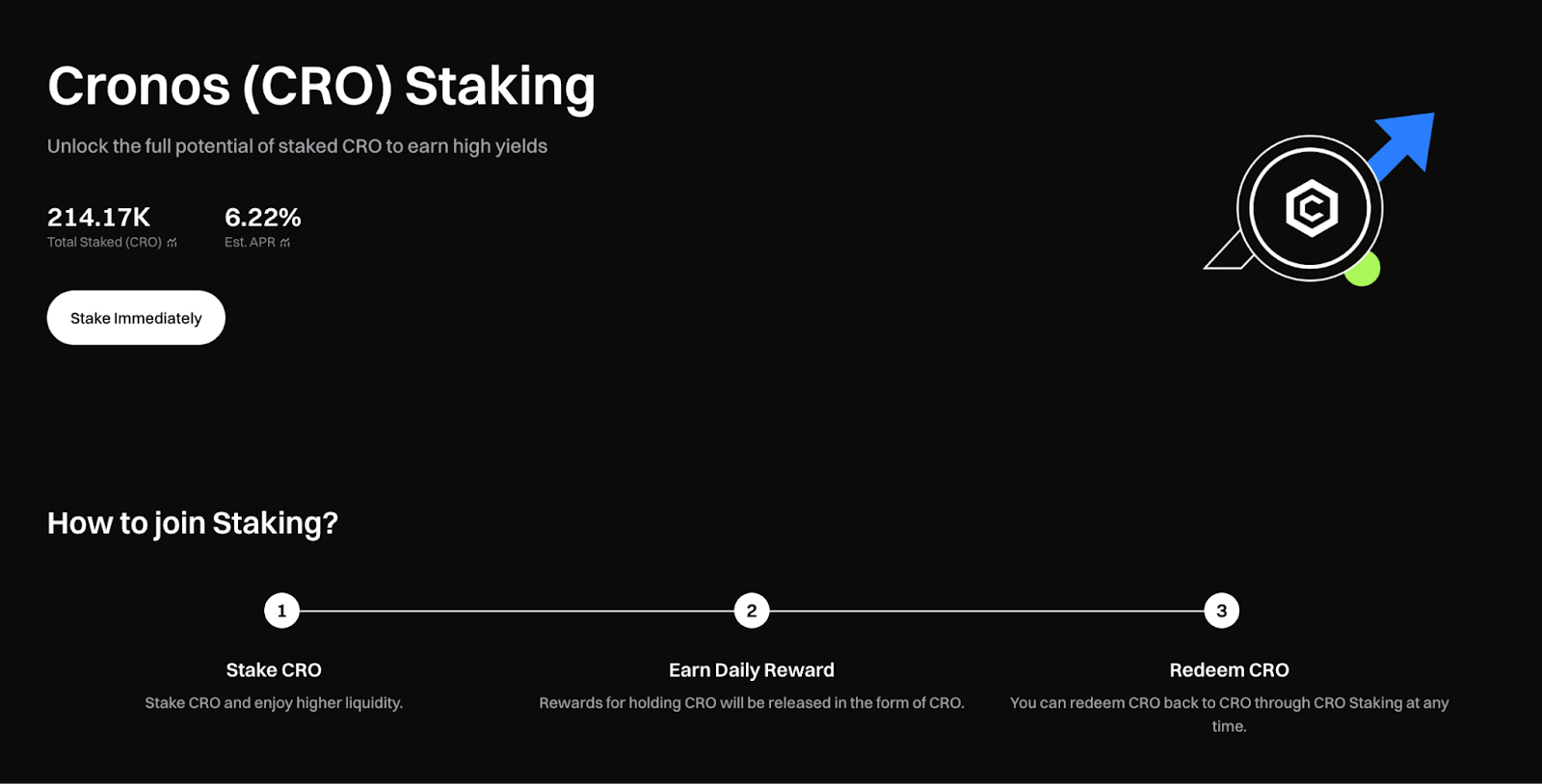

Image: https://www.gate.com/staking/CRO

CRO staking leverages the Proof-of-Stake (PoS) consensus mechanism of the Cronos blockchain. By staking CRO, users help secure and operate the network, earning on-chain rewards in return. Gate Wealth Management has simplified this process: users can stake directly through the Gate platform without needing to manually authorize wallets or select validator nodes. This significantly lowers the entry barrier for earning on-chain rewards, making it especially accessible for newcomers who may not be familiar with on-chain operations.

How Is the 6.22% Annualized Yield Calculated?

According to the Gate Wealth Management platform, as of December 24, 2025, the reference annualized yield for CRO staking stands at 6.22%. This rate is variable and reflects current network-wide staking ratios and changes in on-chain rewards; actual yields may fluctuate and are determined by the real-time rate displayed on the subscription page. For interest calculation, staking completed on Day D begins accruing interest on Day D+1, with payouts starting on Day D+2. Earnings are automatically credited to user accounts daily in CRO.

Redemption Rules and Investor Suitability

CRO staking adheres to the native redemption mechanism of the Cronos chain. Once a redemption request is submitted, principal funds are credited on Day D+29, and no additional rewards accrue during the redemption period. This structure makes the product well-suited for users with a defined investment horizon who favor medium- to long-term asset allocation, rather than those seeking short-term liquidity.

In general, Gate Wealth Management CRO staking is ideal for investors planning to hold CRO for the long term, looking to minimize operational complexity, and aiming to capture genuine on-chain yields.

Conclusion

Overall, Gate Wealth Management CRO staking offers a transparent, low-barrier, and long-term oriented on-chain investment solution. With a current reference annualized yield of 6.22%, it provides CRO holders with a relatively stable path to asset growth. As long as users understand the redemption cycle and associated market risks, this product can serve as a reliable component in a diversified asset allocation strategy.

Disclaimer
* The information is not intended to be and does not constitute financial advice or any other recommendation of any sort offered or endorsed by Gate.
* This article may not be reproduced, transmitted or copied without referencing Gate. Contravention is an infringement of Copyright Act and may be subject to legal action.

Related Articles

AI-Native Settlement Layers: How United Stables Is Building the Next Financial Rail

Beginner

AI-Native Settlement Layers: How United Stables Is Building the Next Financial Rail

Stablecoins were originally designed as dollar substitutes within exchanges, primarily used for asset pricing and trade settlement. As on-chain financial ecosystems have matured, their role has expanded beyond simple payments to include collateral assets, cross-chain liquidity mediums, and unified settlement units. In particular, as AI systems and automated agents begin to participate directly in economic activity, demand has risen sharply for programmable value units capable of instant settlement. This shift is pushing stablecoins toward the role of foundational financial infrastructure.
2026-02-24 06:51:41
The ve(3,3) Flywheel Explained: How AERO Tokenomics Powers Aerodrome’s DeFi Economy

Beginner

The ve(3,3) Flywheel Explained: How AERO Tokenomics Powers Aerodrome’s DeFi Economy

In the competition for DeFi liquidity, high-inflation mining alone is no longer enough to build lasting advantages. Aerodrome applies the ve(3,3) economic model to redesign token emissions, voting mechanisms, and revenue distribution, creating a liquidity flywheel centered on governance and cash flow. This article examines AERO tokenomics, the veAERO locking mechanism, and protocol revenue models to explain how Aerodrome builds a sustainable DeFi economic system.
2026-02-10 04:41:32
How Does PAXG Work? In-Depth Overview of the Physical Gold Tokenization Mechanism

Beginner

How Does PAXG Work? In-Depth Overview of the Physical Gold Tokenization Mechanism

PAXG (Pax Gold) is a tokenized asset backed by physical gold, issued by the fintech company Paxos and traded on the Ethereum blockchain as an ERC-20 token. The core concept is to tokenize physical gold on-chain, with each PAXG token representing ownership of a certain amount of gold. This structure enables investors to hold and trade gold in the form of a digital asset.
2026-03-09 09:30:10
Aerodrome Tokenomics: How ve(3,3) Powers Base's Most Profitable DEX

Beginner

Aerodrome Tokenomics: How ve(3,3) Powers Base's Most Profitable DEX

AERO is the native token of Aerodrome Finance, a core decentralized exchange and liquidity protocol in the Base ecosystem. It is primarily used for liquidity incentives and ecosystem operations. veAERO is a governance NFT that users receive by locking AERO, representing both voting power and the right to share protocol revenue. Through a dual track structure of AERO as a utility token and veAERO as a governance credential, Aerodrome separates liquidity usage value from long term governance power, allowing participants to act as liquidity providers, governance decision makers, and revenue sharers within the same system.
2026-02-10 04:44:29
How is the price of PAXG determined? Pegging mechanism, trading depth, and influencing factors

Beginner

How is the price of PAXG determined? Pegging mechanism, trading depth, and influencing factors

PAXG (Pax Gold) is a tokenized asset backed by physical gold reserves, launched by fintech firm Paxos and issued as an ERC-20 token on the Ethereum blockchain. The core concept is to digitally represent real-world gold assets, allowing investors to hold and trade gold via the blockchain network. Because each PAXG token corresponds to a specific quantity of physical gold, its price is theoretically expected to closely track the global gold market.
2026-03-09 09:26:51
Hybrid Collateral Stablecoins: Inside United Stables' Stability and Yield Architecture
Beginner

Hybrid Collateral Stablecoins: Inside United Stables' Stability and Yield Architecture

In the early stages of the crypto market, traditional stablecoins mainly relied on single-reserve or single-collateral models. Their primary focus was price stability and payment convenience, which allowed them to become foundational tools for on-chain trading and capital flows. As the market has entered a more mature financial phase, however, this structure has begun to reveal limitations, including high concentration risk and the difficulty of balancing liquidity with yield. These constraints have driven the evolution toward multi-layer collateral and portfolio-based designs, such as the dual-layer hybrid collateral architecture proposed by United Stables, which seeks to redefine the underlying logic of stable assets.
2026-02-24 06:49:50
