Gate GTETH: Redefining Ethereum Staking for a Liquid Market
The Fundamental Challenge of Staking: A Mismatch in Market Timing
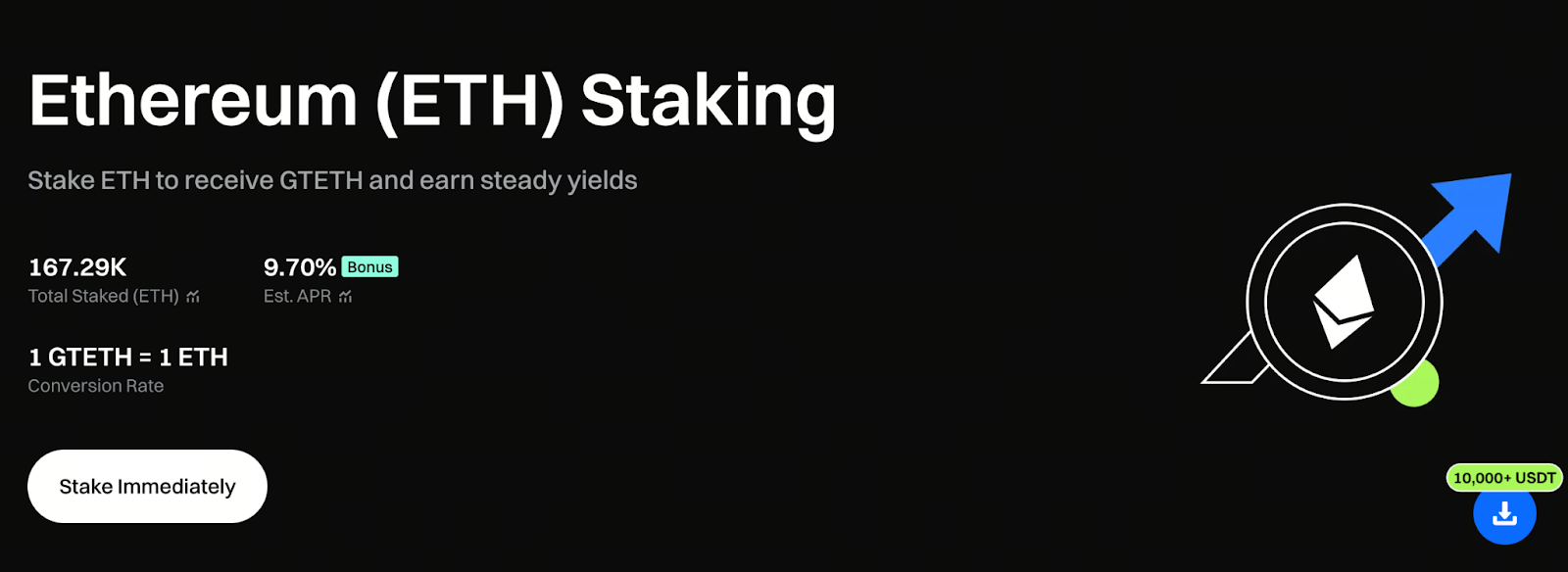
Following Ethereum’s full transition to a PoS framework, staking in theory became a core option for ETH holders. In reality, however, the percentage of users allocating significant capital to staking has never matched the technology’s level of maturity.
The issue isn’t a lack of appetite for stable returns. Rather, the traditional staking model is fundamentally out of step with the highly dynamic, fast-paced crypto market. As trading and asset allocation demand greater flexibility, any capital that’s temporarily inaccessible is viewed as a strategic liability.
Locked Capital: Costlier Than Apparent Returns
From a practical standpoint, ETH staking’s constraints go beyond yield—they surface on multiple levels:
- Unlock periods are unpredictable, making it difficult to align with market cycles
- Reward sources and their accumulation aren’t always transparent
- When markets move quickly, you can’t adjust allocations in real time
These factors make staking more of a long-term commitment than a flexible asset tool. Over time, this dynamic only appeals to holders with low liquidity needs, causing staking to drift away from mainstream market practices.
GTETH: Making Staking a True Asset Option
GTETH isn’t about highlighting PoS technicalities—it’s about reimagining staking from the user’s perspective. For holders, the process is radically simplified: just decide whether to convert ETH to GTETH.
After conversion, node operations, yield generation, and distribution are all handled automatically by the system. Staking shifts from a managed action to an asset class choice, integrating seamlessly into everyday asset allocation and management workflows.
Returns Accrue Directly—No Manual Claims Required
Unlike traditional staking, which requires periodic reward claims, GTETH uses a value-accrual model. Both base PoS rewards from Ethereum and additional GT incentives from Gate are reflected directly in GTETH’s value over time.
While holding GTETH, users don’t need to take any extra action—the ETH value tied to their GTETH increases automatically as rewards accumulate. All yield sources remain fully transparent and verifiable on-chain, ensuring a clear and traceable reward structure.
Liquidity as the Default, Not the Exception
GTETH’s fundamental innovation is removing the assumption that “locking means sacrificing flexibility.” Holders can redeem GTETH for ETH or trade it on the open market at any time—no waiting for fixed unlock periods. Yield and liquidity no longer compete; they coexist in a single asset, letting ETH staking finally keep pace with market operations.
From Yield Tool to Strategic Allocation Instrument
Once liquidity constraints are removed, GTETH’s role evolves. No longer just a staking alternative, it becomes an ETH allocation unit for strategic portfolio management. Whether you’re reducing exposure in volatile markets or reallocating capital to new opportunities, GTETH enables these moves while preserving staking yields—integrating staking into the broader investment strategy rather than sidelining it.
Clear Return Structure, Quantifiable Long-Term Efficiency
GTETH’s yield comes from two main sources:
- Ethereum PoS staking rewards: approximately 2.7% annualized
- Additional GT incentives from Gate: approximately 7% annualized
All accumulated returns are reflected when you finally redeem for ETH, making the entire process straightforward and transparent.
Start staking ETH with Gate now and begin your on-chain yield journey: https://www.gate.com/staking/ETH?ch=ann46659
VIP Levels Shape the Final Compounding Curve
GTETH’s fee structure is tied to Gate VIP tiers. The base fee rate is 6%, with discounts based on your VIP level:
- VIP 5–7: 20% fee discount
- VIP 8–11: 40% fee discount
- VIP 12–14: 60% fee discount
While each transaction’s difference may be modest, over time and with compounding, fees become a critical factor shaping total returns.
How GTETH Differs from Mainstream LSTs
Most liquid staking tokens are simply representations of locked positions, offering limited liquidity and utility. GTETH, by contrast, functions as a real asset management tool—its value adjusts naturally with accrued yields and allows free entry and exit from the market. With this design, staking becomes an ETH management approach that adapts alongside your trading strategies, not a static allocation.
Summary
GTETH’s value isn’t in technical complexity, but in redefining staking’s role within the investment portfolio. It preserves the stable yield potential of PoS while eliminating the capital and psychological burdens of lockups, enabling ETH staking to move in sync with market dynamics. Now that PoS is standard for Ethereum, staking no longer needs to be a rigid, long-term commitment—it can be a flexible, yield-generating allocation in line with modern Web3 asset management logic.
Related Articles

AI-Native Settlement Layers: How United Stables Is Building the Next Financial Rail

The ve(3,3) Flywheel Explained: How AERO Tokenomics Powers Aerodrome’s DeFi Economy

How Does PAXG Work? In-Depth Overview of the Physical Gold Tokenization Mechanism

Aerodrome Tokenomics: How ve(3,3) Powers Base's Most Profitable DEX

How is the price of PAXG determined? Pegging mechanism, trading depth, and influencing factors
