Gate GTETH: A Liquid Staking Approach Built for Faster Markets
When Market Momentum Accelerates, Capital Can’t Afford to Wait
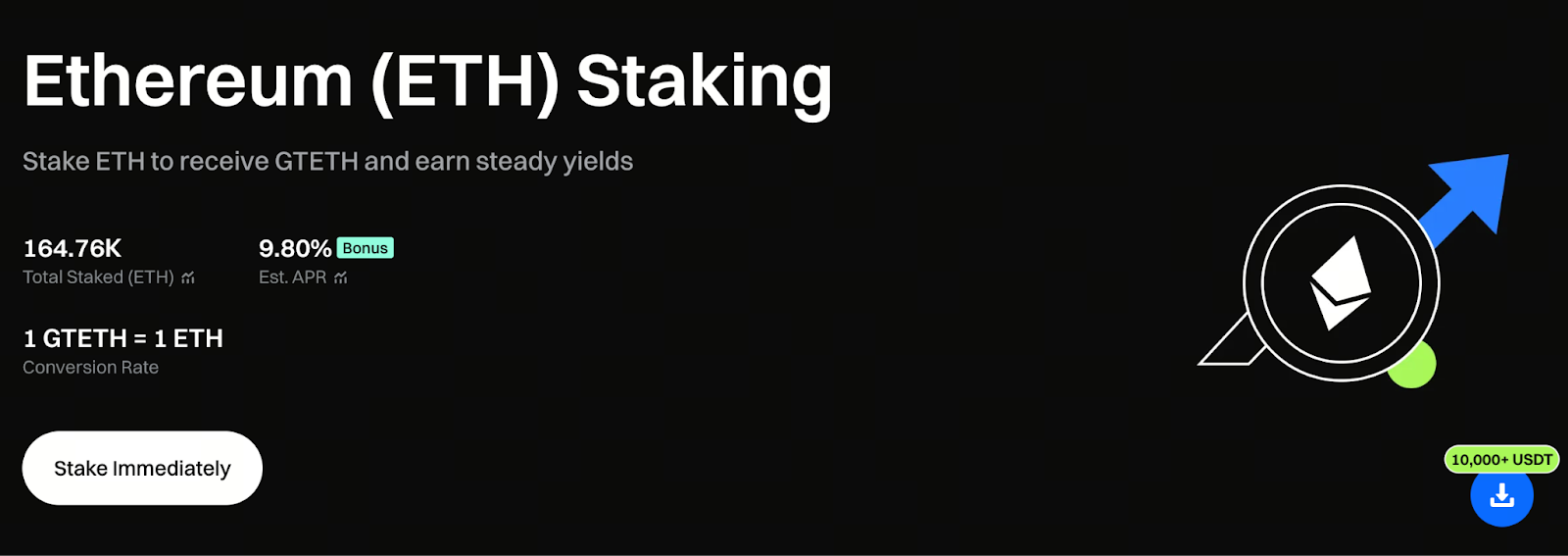
Since Ethereum’s full transition to PoS, staking has become the default choice for ETH holders. Yet as market cycles speed up, this seemingly sensible option increasingly diverges from what active management requires. In an environment defined by constant capital rotation, any asset structure that forces holders to wait for unlocks or prevents real-time adjustments directly undermines operational efficiency. The real question isn’t whether staking yields are attractive—it’s whether staking still keeps up with today’s market tempo.
What Users Truly Lose Is Control Over Adjustments
Most traders don’t reject stable returns—they’re uneasy about being locked into positions with no easy exit. In practice, traditional ETH staking typically faces several constraints:
- Unable to exit positions instantly when the market reverses
- Fragmented yield calculations that complicate holistic asset management
- Staked funds remain passive, making strategic reallocation difficult
Over time, staking shifts from an active allocation to a static position that’s hard to deploy flexibly.
GTETH: Turning Staking Into a Usable Asset
GTETH isn’t about simplifying PoS’s technical details—it fundamentally transforms how staking exists. Users don’t need to understand node mechanics or reward distribution. They only need to do one thing: convert ETH to GTETH. After conversion, staking ceases to be a process and becomes an attribute of the asset itself. GTETH is an ETH-based asset that can be held, traded, or included in portfolio allocations, letting staking naturally integrate into everyday capital management instead of being siloed from strategy.
Yield Is Built Into the Asset Price—No Waiting Required
Unlike traditional staking models that require periodic claims, GTETH embeds yield directly into the asset. Both the baseline PoS rewards from Ethereum and the additional GT incentives from Gate are reflected in GTETH’s value over time. For holders, returns aren’t claimed in batches—they accrue automatically and continuously while holding. All reward sources remain fully verifiable on-chain, ensuring structural transparency and traceability.
Liquidity Is Standard—Not a Trade-Off
GTETH’s key distinction from traditional staking is that it doesn’t require lockups. Holders can redeem GTETH for ETH whenever they want, or trade it in the market, without waiting for a fixed unlock period. This design means yield and liquidity are no longer mutually exclusive—they coexist in a single asset. For the first time, staking doesn’t slow operational momentum but keeps pace with the market.
From Passive Returns to Configurable ETH Units
Once liquidity constraints are removed, GTETH’s role evolves. It’s not just a staking alternative—it’s an ETH allocation unit that fits into broader asset management. Whether you need to reduce exposure during risk spikes or quickly adjust positions when opportunities arise, GTETH enables seamless transitions while preserving staking yields, ensuring staking is no longer isolated from your investment portfolio.
Transparent Yield Structure, Quantifiable Long-Term Efficiency
GTETH’s yield sources are straightforward, comprising two main components:
- Ethereum PoS staking yield: approximately 2.8% annualized
- Additional GT incentives from Gate: approximately 7% annualized
All accumulated rewards are reflected in your final ETH redemption, making long-term efficiency clear and measurable.
Join Gate ETH staking now and start your on-chain yield journey: https://www.gate.com/staking/ETH?ch=ann46659
VIP Level Determines Long-Term Compound Yield Outcomes
GTETH’s fee structure is directly tied to Gate VIP levels. The standard fee rate is 6%, with discounts by tier:
- VIP 5–7: 20% fee discount
- VIP 8–11: 40% fee discount
- VIP 12–14: 60% fee discount
Short-term effects may be minor, but over longer holding periods and with compounding, fee rates often become the decisive factor in final yield differentials.
A Different Approach Than Mainstream LSTs
Most liquid staking tokens remain simple representations of locked positions, with limited use cases and strategic flexibility. GTETH, by contrast, functions as a daily asset management tool—its value adjusts naturally with yield and allows unrestricted market entry and exit. With this design, staking is no longer a static choice but an ETH management method that adapts in sync with trading strategies.
Conclusion
GTETH doesn’t make staking more complicated—it redefines its role in asset allocation. It preserves PoS’s stable yield potential while eliminating lockup restrictions that hinder capital efficiency, letting ETH staking truly match market momentum. Now that PoS is the default for Ethereum, staking no longer needs to be a rigid long-term commitment—it can be a configuration option that balances liquidity and returns, perfectly aligned with modern Web3 asset management logic.
Related Articles

AI-Native Settlement Layers: How United Stables Is Building the Next Financial Rail

The ve(3,3) Flywheel Explained: How AERO Tokenomics Powers Aerodrome’s DeFi Economy

How Does PAXG Work? In-Depth Overview of the Physical Gold Tokenization Mechanism

Aerodrome Tokenomics: How ve(3,3) Powers Base's Most Profitable DEX

How is the price of PAXG determined? Pegging mechanism, trading depth, and influencing factors
