What Is the Difference Between Gate.AI and Directly Calling the OpenAI API? A Comprehensive Comparison of AI Gateway and Single-Model Integration
As large language models (LLMs) increasingly become critical infrastructure for AI applications, developers building intelligent assistants, automated workflows, and AI agents often face a choice: directly call the OpenAI API or use an AI Gateway platform to centrally manage model calls. Both approaches enable AI functionality, but they differ significantly in system architecture, scalability, and operational complexity.
Against the backdrop of an evolving multi-model ecosystem, enterprises and developers increasingly prefer to use different models simultaneously—such as GPT, Claude, Gemini, and DeepSeek. How to centrally manage model resources, reduce vendor dependency risk, and improve system availability has become a critical topic in AI infrastructure. Gate.AI emerged precisely as a model routing and AI Gateway platform under this context, with a positioning fundamentally different from traditional single-model API integration.
What Is the OpenAI API?
The OpenAI API is an interface provided by OpenAI that allows developers to call GPT series models via standard APIs and integrate them into chatbots, content generation tools, search systems, and automated applications.
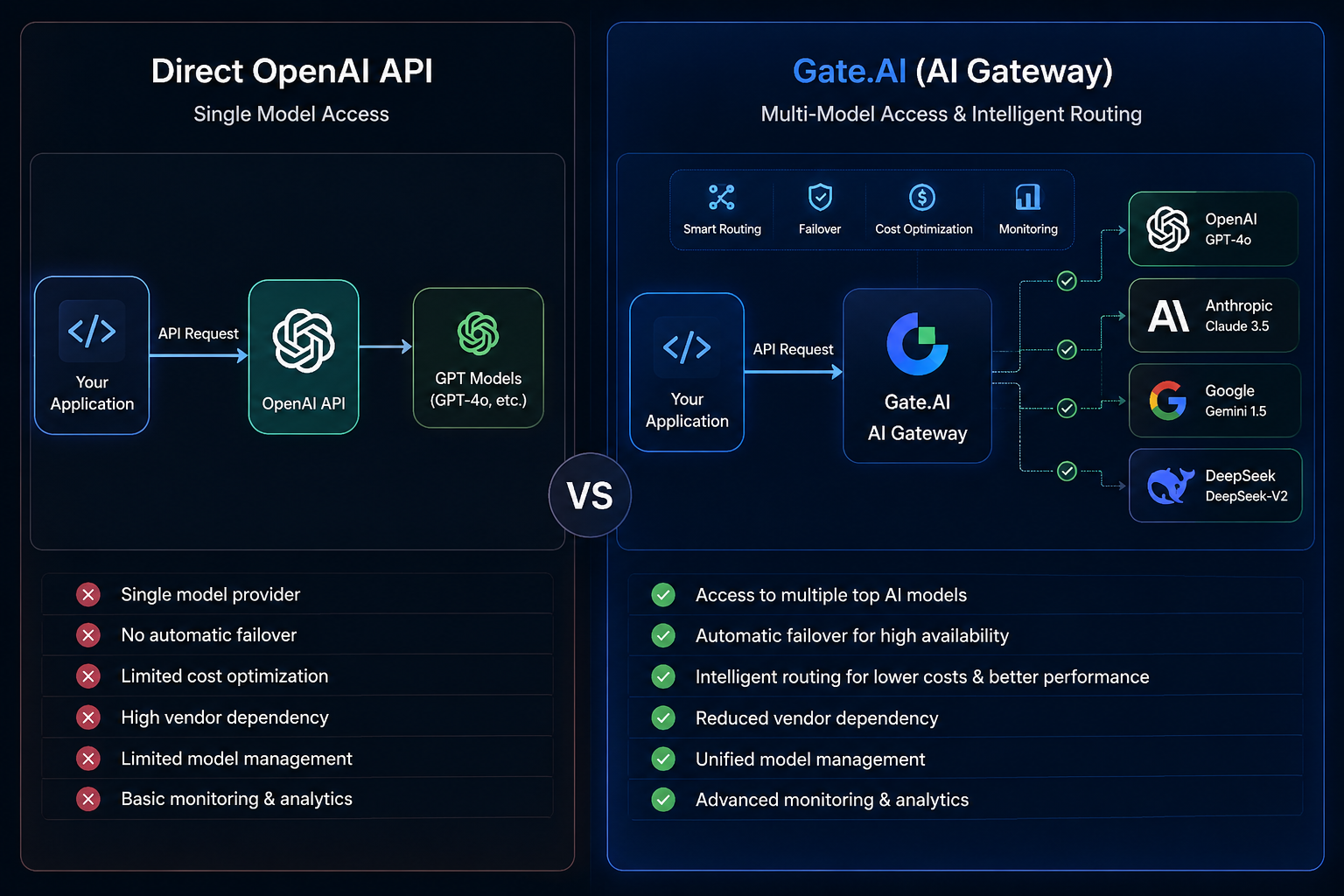
In this model, applications send requests directly to OpenAI, which returns model inference results. The entire call chain is relatively simple; developers only need to manage a single vendor's interface to complete deployment.
This architecture is suitable for early product validation, single-model applications, and scenarios with clear requirements. However, as business scale grows, issues such as limited model selection, strong vendor dependency, and insufficient failure recovery emerge.
What Is Gate.AI?
Gate.AI, as a model routing platform for AI applications and AI agents, connects multiple mainstream AI model services through a unified interface.
Unlike directly calling a single model, Gate.AI sits between the application and the model services, acting as an AI Gateway, performing model routing, request governance, and model switching.
Developers do not need to develop separate interfaces for different models; instead, they access models through a unified entry point. When one model becomes unavailable, the system can automatically switch to another model based on preset rules, thereby improving overall availability and stability.
How Does the Model Coverage of OpenAI API Differ from Gate.AI?
Model coverage is one of the most obvious differences between the two approaches.
When directly calling the OpenAI API, developers can access models provided by OpenAI but cannot directly use other model services.
In contrast, Gate.AI's design goal is to aggregate resources from multiple model providers, enabling developers to access different model capabilities through a single interface.
For example, an application might use GPT for complex reasoning tasks, Claude for long-text analysis, and DeepSeek for code generation. Through the model routing platform, these capabilities can be managed centrally.
This approach helps avoid vendor lock-in and improves system flexibility.
Architectural Differences: AI Gateway vs. Single-Model Integration
From an architectural perspective, the two belong to different layers of infrastructure.
Directly calling the OpenAI API is an application layer directly connecting to a model layer:
Application → OpenAI API → GPT Model
Gate.AI adds an AI Gateway layer in between:
Application → Gate.AI → Multi-Model Ecosystem
The responsibilities of the AI Gateway go beyond forwarding requests; it also handles:
- Model routing
- Request governance
- Access control
- Monitoring and auditing
- Load balancing
- Failure recovery
Therefore, the two are not simply a matter of substitution; they represent different architectural patterns adopted by systems of varying complexity.
How Do the Cost Control Capabilities of OpenAI API and Gate.AI Differ?
As AI application scale grows, model call costs become an important consideration.
In a single-model architecture, all requests are sent to the same model, generating the same level of inference cost even when certain tasks do not require the highest-performing model.
A model routing platform can dynamically select models based on task complexity.
For example:
- Simple Q&A uses lightweight models
- Content summarization uses medium models
- Complex reasoning uses high-performance models
This tiered scheduling approach helps improve resource utilization and reduce overall inference costs.
Therefore, multi-model architectures typically offer greater cost optimization potential than fixed-model architectures.
How Do the Failure Recovery and Availability of OpenAI API and Gate.AI Differ?
AI applications have increasingly high demands for stability.
When developers directly integrate a single model service, requests may directly fail if the service experiences downtime, response timeouts, or rate limiting.
A multi-model Gateway architecture can achieve automatic failure recovery through a fallback mechanism.
When the primary model fails to respond, the system can automatically switch the request to a backup model.
This mechanism reduces the risk of single points of failure and improves continuous system operation.
For long-running AI agents or automated workflows, model failover has become a key infrastructure capability.
Core Differences Between Gate.AI and OpenAI API
| Comparison Dimension | Gate.AI | OpenAI API |
|---|---|---|
| Positioning | AI Gateway and model routing platform | Single model service interface |
| Model Source | Multi-model ecosystem | OpenAI models |
| Model Switching | Supported | Not supported |
| Automatic Fallback | Supported | Not supported |
| Centralized Management | Supported | Limited |
| Cost Optimization | Supports dynamic routing | Fixed model calling |
| AI Agent Adaptability | High | Medium |
| Vendor Dependency | Low | High |
| Extensibility | Strong | Relatively limited |
What Scenarios Are Suitable for Directly Calling the OpenAI API?
For prototype validation, small projects, and applications that rely specifically on GPT models, directly calling the OpenAI API typically allows for quick deployment with lower complexity.
When the system is small in scale, model requirements are singular, and failure recovery requirements are low, the single-model architecture offers the advantages of low implementation cost and simple maintenance.
What Scenarios Are More Suitable for Using Gate.AI?
For long-running AI products, enterprise-level applications, and AI agent systems, multi-model management capabilities are often more important than single-model capabilities.
When the system requires:
- Using multiple models simultaneously
- Reducing vendor dependency
- Automatic failure switching
- Cost optimization
- Centralized governance and monitoring
An AI Gateway architecture typically provides higher flexibility and scalability.
Summary
The difference between Gate.AI and directly calling the OpenAI API essentially comes down to the difference between an AI Gateway architecture and a single-model integration architecture.
The OpenAI API provides direct access to a single model ecosystem, suitable for quickly building and deploying AI applications; Gate.AI, on the other hand, provides infrastructure support for multi-model collaboration, high-availability systems, and AI agents through model routing and a unified gateway mechanism.
FAQs
Are the OpenAI API and Gate.AI competitors?
The two are not entirely on the same level. The OpenAI API is a model service provider, while Gate.AI is a model routing and AI Gateway platform that can include OpenAI models as one of its accessible resources.
Does Gate.AI only connect to OpenAI models?
No. Gate.AI's goal is to unify access to multiple AI model ecosystems, allowing developers to access different model capabilities through a single interface.
What is an AI Gateway?
An AI Gateway is an infrastructure layer between applications and models, responsible for request forwarding, model routing, permission management, monitoring and governance, and failure recovery.
What does the fallback mechanism mean?
Fallback is an automatic failure recovery mechanism. When the primary model is unavailable, the system automatically switches to a backup model to continue processing the request, thereby reducing service disruption risk.
Does using an AI Gateway mean you cannot directly select a model?
No. An AI Gateway typically supports both automatic model routing and manual specification of the target model by developers; both modes can be flexibly configured based on specific needs.
Related Articles
Arweave: Capturing Market Opportunity with AO Computer
The Upcoming AO Token: Potentially the Ultimate Solution for On-Chain AI Agents

AI+Crypto Landscape Explained: 7 Major Tracks & Over 60+ Projects
0G vs Bittensor: Key Differences Between AI Infrastructure Layer and Decentralized AI Model Network

What is AIXBT by Virtuals? All You Need to Know About AIXBT