Ethereum Faces Key $3,400 Resistance: Is a Breakout Imminent or a Pullback Ahead?
1. Latest Ethereum Price Overview
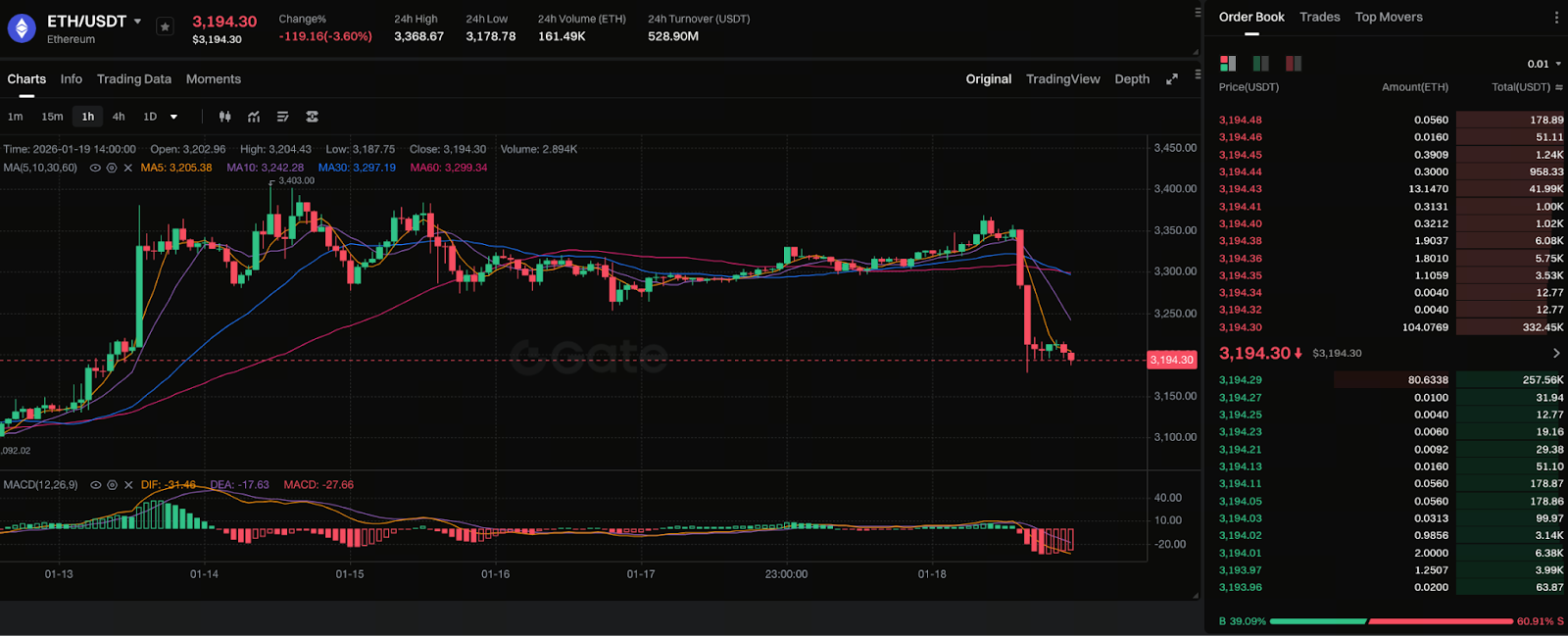
Chart: https://www.gate.com/trade/ETH_USDT
As of January 19, 2026, Ethereum (ETH) has been trading in the $3,200–$3,400 range, repeatedly attempting upward breakouts but still unable to establish a sustained move above resistance. Bulls and bears are locked in a clear standoff near critical price levels, and market sentiment is increasingly split on the next direction. Bulls are pushing for a decisive breakout to open further upside, while bears are leveraging the resistance zone to drive short-term pullbacks.
2. Why $3,400 Is a Key Resistance Level
The $3,400 mark is regarded as a major inflection point for Ethereum’s short- and medium-term trend due to several factors:
First, this price level coincides with a previous concentration of trading activity—a zone where many historical positions are clustered and investors are likely to take profits.
Second, from a technical perspective, the overlap of Fibonacci retracement, structural resistance, and major horizontal support lines makes $3,400 a formidable barrier. ETH needs substantial volume to challenge and break through this area.
Third, institutions and large holders have repeatedly initiated short-term sell orders in this region, meaning a successful breakout requires clear buying power.
Thus, $3,400 is not only a psychological threshold but also embodies structural market pressure.
3. Technical Analysis: Breakout Signals and Pullback Conditions
For a true breakout, several conditions must be met:
- First, the closing price must remain above $3,400, accompanied by a surge in trading volume.
- Second, the daily chart should show a sustained bullish pattern, including clear upward divergence in the moving averages.
- Third, there should be a noticeable net inflow of capital, along with rising on-chain activity.
If these conditions are not met, the likelihood of a pullback increases. Specifically, if ETH posts a long upper shadow or volume declines near $3,400, the price may retreat to the $3,200 or even $3,100 range for support testing.
Recent market data also suggests that high time-frame resistance is suppressing ETH, and trading volume has not risen significantly, increasing short-term pullback risk.
4. Impact of Fundamental Changes on ETH
In addition to technical factors, fundamental changes are also key drivers of ETH’s price action. Recently, transaction activity and staking volume on the Ethereum network have shown moderate growth, providing long-term value support. Institutional interest in ETH is also rising, as evidenced by increased discussions of ETF products and shifts in capital flows, which shape expectations for future market trends.
However, potential headwinds remain. Periodic large wallet sell-offs may impact short-term price movements, while the pace of Ethereum network upgrades, gas costs, and competition from rival blockchains could also create challenges.
5. Market Sentiment and Capital Flows
Overall, ETH investors maintain a cautiously optimistic outlook, but there are no signs of aggressive buying. Capital flow data shows that while institutions are increasing their long-term ETH allocations, short-term capital tends to reduce positions near key resistance. Broader macro factors—such as shifting Federal Reserve policy expectations and the overall risk asset environment—also influence ETH’s short-term volatility.
Until sentiment shifts decisively and capital flows accelerate, a breakout will depend on whether the market can generate collective momentum.
6. Key Price Levels and Strategic Reference for the Coming Market
Looking ahead, the following levels warrant close attention:
- First, whether $3,400 can be decisively broken and held—this is critical for trend direction.
- Second, if a pullback occurs, $3,200 is a major short-term support. If breached, $3,100 may be tested next.
- Third, if a breakout is confirmed, the $3,500–$3,800 range will be the next target zone.
Investors should tailor their strategies based on breakout scenarios to mitigate risks from uncertain market conditions.
7. Conclusion: Assessing ETH’s Potential Trend
In summary, Ethereum’s performance at the $3,400 level will shape its short-term trajectory. If trading volume and market sentiment improve in tandem, the odds of a breakout rise substantially. Conversely, repeated failures and pullbacks could lead to consolidation or a short-term correction cycle. The market is at a pivotal juncture, and investors should closely monitor price structure, trading volume shifts, and macroeconomic signals in concert.
Related Articles

AI-Native Settlement Layers: How United Stables Is Building the Next Financial Rail

The ve(3,3) Flywheel Explained: How AERO Tokenomics Powers Aerodrome’s DeFi Economy

How Does PAXG Work? In-Depth Overview of the Physical Gold Tokenization Mechanism

Aerodrome Tokenomics: How ve(3,3) Powers Base's Most Profitable DEX

How is the price of PAXG determined? Pegging mechanism, trading depth, and influencing factors
