Ethereum (ETH) 2026: Glamsterdam and Hegota forks, L1 scaling and more
Next year, Ethereum will achieve seamless parallel processing, with a dramatic increase in both the gas limit and the number of data blobs. Additionally, 10% of the Ethereum network will transition to zero-knowledge (ZK) technology.
The upcoming year marks a crucial phase for Ethereum’s scalability. In 2026, the Glamsterdam fork will introduce advanced parallel processing and raise the blockchain’s gas limit from the current 60 million to 200 million.
A large number of validators will shift from re-executing transactions to verifying zero-knowledge proofs. This shift will drive Ethereum Layer 1 toward 10,000 transactions per second (TPS), with the potential to surpass that milestone, even though such speeds may remain out of reach in 2026.
At the same time, the number of data blobs per block will increase (potentially reaching 72 or more), enabling Layer 2 (L2) networks to handle hundreds of thousands of transactions per second. L2 user experience is steadily improving; ZKsync’s recent Atlas upgrade allows users to keep funds on the mainnet while executing high-speed on-chain transactions within the ZKsync Elastic Network ecosystem.
The planned Ethereum interoperability layer will enable seamless cross-chain activity between L2s. Privacy protection will take center stage, with further enhancements to on-chain censorship resistance scheduled for the year-end Heze-Bogota fork.
Ethereum in 2026: The Glamsterdam Fork
Ethereum developers are finalizing which Ethereum Improvement Proposals (EIPs) will be included in the Glamsterdam hard fork, scheduled for mid-2026. Confirmed core upgrades include block access lists and native proposer-builder separation. While these upgrade names may seem uninspiring, they are expected to accelerate blockchain efficiency ahead of the transition to ZK technology.
Development teams may eventually rebrand these technical modules with more memorable names, like “Firedancer.” For now, the current technical terminology remains in use.
Glamsterdam: Block Access Lists (EIP-7928)
Although “block access lists” might sound like a censorship tool, this upgrade will actually deliver robust block-level parallel processing.
Until now, Ethereum has operated in a single-threaded mode, with all transactions queued and executed one after another. Block access lists will enable throughput to scale like a multi-lane highway, processing multiple transactions in parallel.
A block access list is a mapping created by the block producer for each block, prioritizing execution of all transactions on high-performance hardware. This list informs Ethereum clients about which transactions affect others, accounts, and storage slots, and records state changes after each transaction. This lets Ethereum allocate transactions across multi-core CPUs for parallel execution, eliminating conflicts.
“With block access lists, we can capture all state changes from each transaction and include this information in the block,” said Gabriel Trintinalia, Senior Blockchain Engineer at Consensys, who worked on the Besu execution client.
This mechanism also allows clients to preload all necessary data from disk into memory at once, avoiding repeated sequential disk reads. Trintinalia described this as “the biggest bottleneck we’ve encountered.”
Comprehensive parallel processing will enable Ethereum to achieve higher throughput and larger block capacity without raising the gas limit.
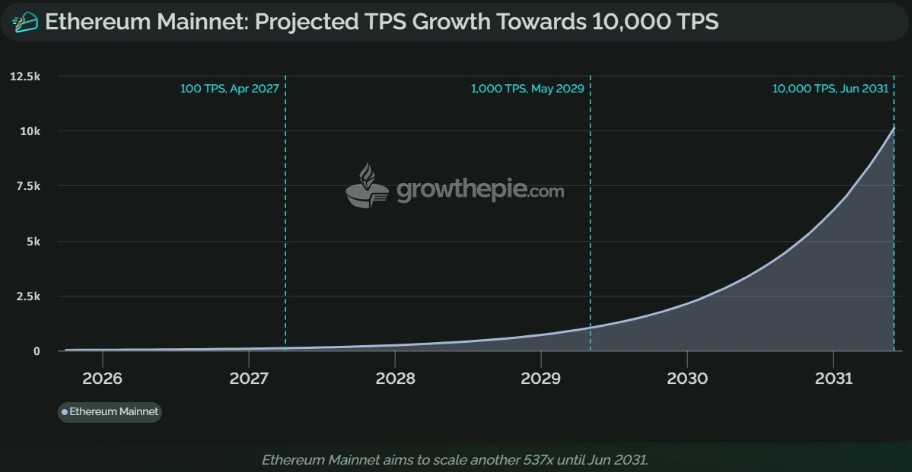
After the 2026 upgrade, Ethereum L1 is projected to reach 10,000 TPS. Source: Growthepie
Glamsterdam: Native Proposer-Builder Separation
The separation of block builders and proposers began with MEV Boost, an off-chain solution that uses centralized relays as intermediaries and currently manages about 90% of block production. Native proposer-builder separation (ePBS) will integrate this process directly into Ethereum’s consensus layer, enabling trustless operation.
The core idea is that block builders compete to select and order transactions optimally to construct blocks, while proposers choose which block to propose. This approach aims to reduce centralization pressures from maximal extractable value (MEV) while increasing security, decentralization, and censorship resistance.
From a scaling perspective, the greatest advantage of ePBS is that it provides more time for the network to generate and propagate ZK proofs. Currently, validators are penalized for delays, so they lack motivation to wait for ZK proof verification. ePBS will give the network more time to receive and verify ZK proofs.
This gives attesters more buffer time to receive proofs (and proof generators more time to produce them), according to Ethereum researcher Ladislaus von Daniels. He also noted that ePBS decouples block validation from execution, enabling new possibilities for delayed execution.
This upgrade significantly improves incentive compatibility for validators who voluntarily participate in zkAttesting.
Ethereum Foundation researcher Justin Drake expects around 10% of validators to switch to ZK verification, paving the way for future gas limit increases.
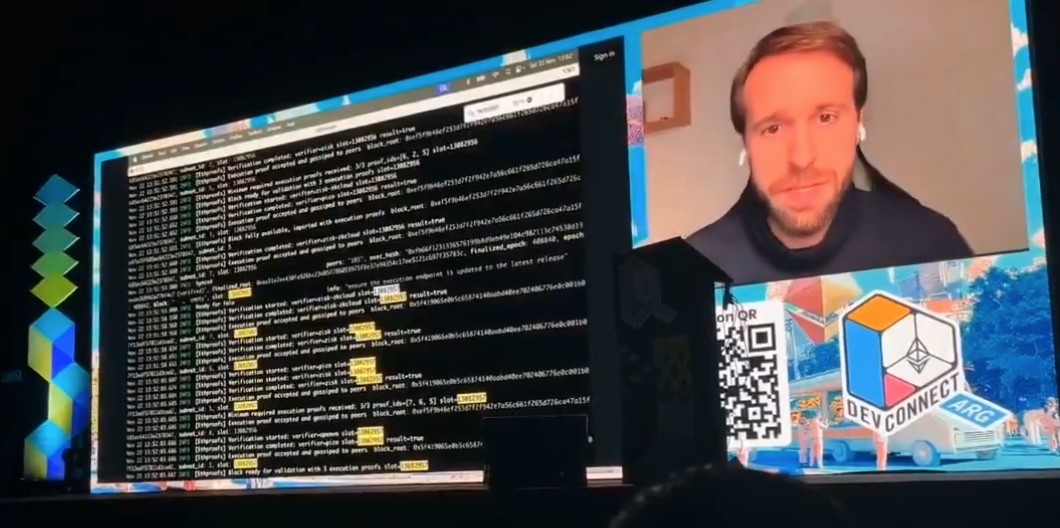
Ethereum Foundation researcher Justin Drake demonstrates ZK proof verification. Source: EthProofs
Ethereum L1 Gas Limit Increase and L2 Blob Metric Upgrades
The L1 gas limit (which determines mainnet throughput) has already been raised to 60 million. By 2026, a significant increase is expected, though the exact number is still under discussion.
“I think we’ll see 100 million within 2026 fairly soon. Higher numbers are harder to forecast,” said Gary Schulte, Senior Blockchain Protocol Engineer for the Besu client. He added that delayed execution could allow for further gas limit increases.
Ethereum Foundation Co-Lead Tomasz Stańczak revealed at a recent Bankless summit that the gas limit will rise to 100 million in the first half of 2026, with a projected doubling to 200 million following ePBS implementation. With further optimization, single-block gas could reach 300 million, possibly by year-end.
Ethereum founder Vitalik Buterin takes a more cautious stance. At the end of last November, he stated, “I expect continued growth next year, but with more targeted/non-uniform growth. For example, one possibility is: the gas limit increases fivefold, while the gas cost for relatively inefficient operations also increases fivefold.” Buterin cited storage, precompiles, and contract calls for large contracts as examples.

Ethereum expansion is accelerating in 2026. Source: TenaciousBit
Ethereum’s Second Fork in 2026: Heze-Bogota
This fork is expected to include some EIPs left over from Glamsterdam. However, according to Forkast, the only EIP currently on the “to be included” list is the Fork Choice Inclusion List (FOCIL). This proposal was originally slated for Glamsterdam but was postponed due to controversy and workload.
This fork is not focused on scalability, but rather on the anti-censorship goals championed by cypherpunks. It empowers multiple validators to force the inclusion of specific transactions in every block, thereby enhancing censorship resistance.
“This is a censorship-resistance mechanism. As long as some nodes on the network remain honest… the transaction will eventually be included in a block,” said Trintinalia.
Stay tuned for part two, where we’ll take a deeper dive into L1 scaling based on ZK proofs in 2026.
Statement:
- This article is republished from [Cointelegraph]. Copyright belongs to the original author [Andrew Fenton]. If you have any objections to this reprint, please contact the Gate Learn team, and we will handle it promptly according to relevant procedures.
- Disclaimer: The views and opinions expressed in this article are solely those of the author and do not constitute investment advice.
- Other language versions of this article are translated by the Gate Learn team. Do not copy, distribute, or plagiarize the translated article without crediting Gate.
Related Articles

What Is Ethereum 2.0? Understanding The Merge
Our Across Thesis

Reflections on Ethereum Governance Following the 3074 Saga

What is Neiro? All You Need to Know About NEIROETH in 2025
What is Polygon 2.0 (POL)? From MATIC to POL (2025)