DFINITY Unveils “Mission 70” White Paper to Expand the Internet Computer Economy
“Mission 70” White Paper Officially Released
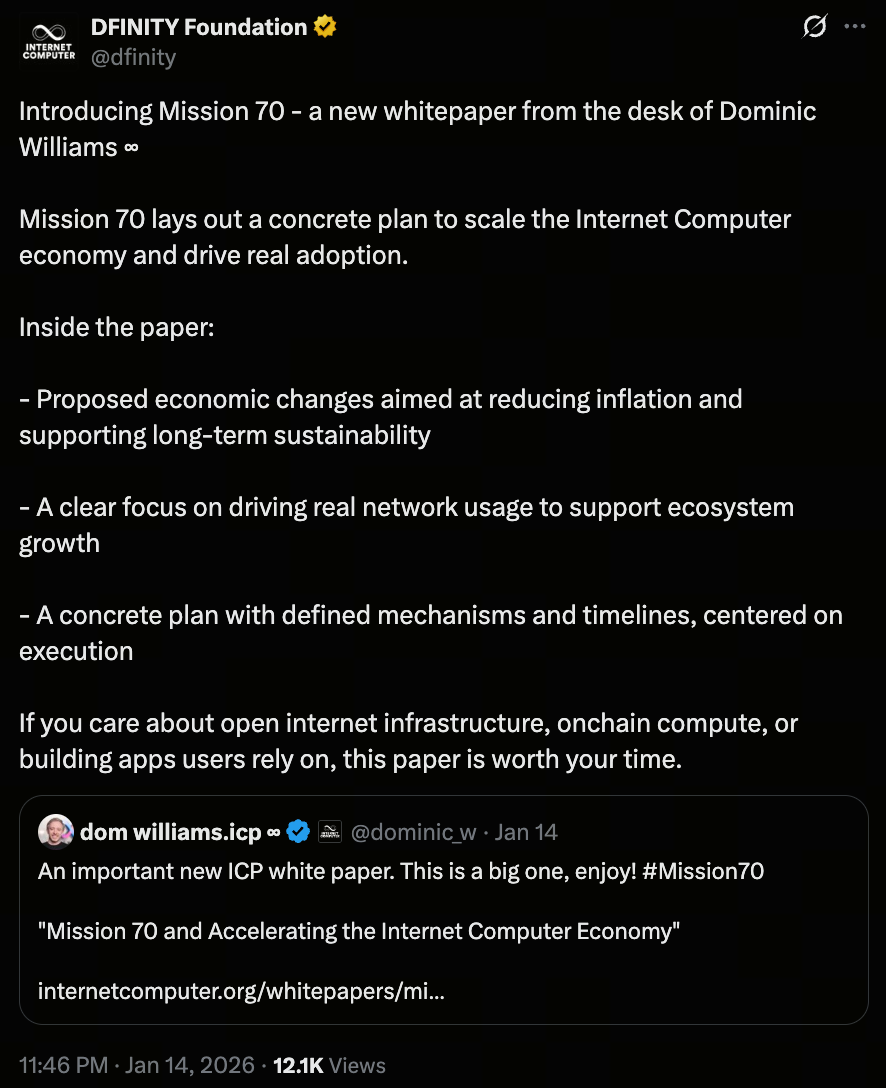
The DFINITY Foundation has announced the release of its new white paper, “Mission 70,” authored by founder Dominic Williams. This document outlines the next phase of Internet Computer’s development strategy, with a focus on expanding the overall economic scale and accelerating real-world adoption of the network.
(Source: DFINITY)
Unlike previous vision-driven statements, the white paper presents a clear and actionable roadmap for the long-term growth of Internet Computer.
Focus on Economic Structure and Long-Term Sustainability
“Mission 70” introduces a series of economic design adjustments, primarily aimed at reducing inflationary pressures and building a more resilient foundation for sustainable ecosystem growth. These reforms are designed to balance network expansion with resource allocation, ensuring the economic model can support future scaling.
DFINITY emphasizes that a stable and sustainable economic structure is essential for Internet Computer’s large-scale adoption.
Ecosystem Growth Driven by Real-World Usage
Departing from previous technology-centric approaches, the white paper identifies real-world network usage as a core objective. By encouraging the deployment of practical applications on Internet Computer, DFINITY aims to increase developer and user engagement, creating a positive feedback loop for ecosystem development.
This strategy signals a shift in focus toward user-reliable application scenarios, moving beyond infrastructure-centric construction.
Concrete Action Plans Emphasizing Execution
A key aspect of “Mission 70” is its focus on execution. The white paper details specific operational mechanisms and timelines, designed to turn strategic concepts into actionable initiatives. Through structured pacing and implementation frameworks, DFINITY aims to improve the feasibility of its overall strategy and provide the community and builders with a clear path forward.
To learn more about Web3, click to register: https://www.gate.com/
Conclusion
The “Mission 70” white paper marks a new direction for DFINITY and the future of Internet Computer. Covering economic reforms, real-world application growth, and execution planning, it signals a stronger trajectory for the ecosystem. For those interested in open network infrastructure, on-chain computation, and practical applications, this document serves as a key reference for tracking the next steps of the ICP ecosystem.
Related Articles

AI-Native Settlement Layers: How United Stables Is Building the Next Financial Rail

The ve(3,3) Flywheel Explained: How AERO Tokenomics Powers Aerodrome’s DeFi Economy

How Does PAXG Work? In-Depth Overview of the Physical Gold Tokenization Mechanism

Aerodrome Tokenomics: How ve(3,3) Powers Base's Most Profitable DEX

How is the price of PAXG determined? Pegging mechanism, trading depth, and influencing factors
