Creativity in the AI Era: How Ordinary People Can Move from Passive Tool Use to Actively Shaping Personal Value
Why Creativity Matters More Than Ever for Everyday People in the Age of AI
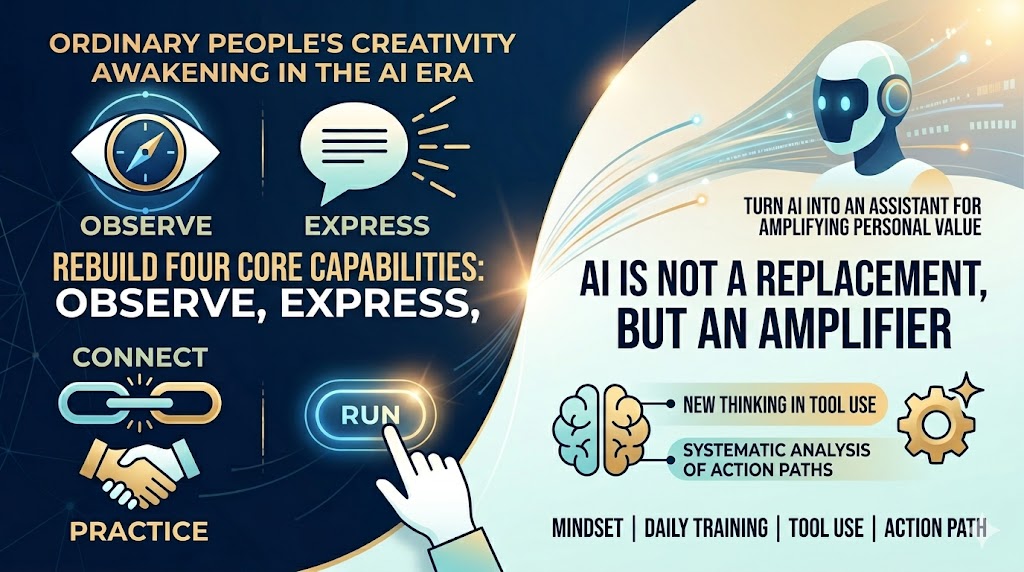
As generative AI evolves rapidly, tasks like writing copy, summarizing, organizing information, generating images, and drafting initial plans are becoming increasingly inexpensive and efficient. What once took hours can now be accomplished in minutes. At first glance, it may seem that "the more powerful the tools, the less important people become." In reality, the opposite is true.
As execution-based work becomes dramatically more efficient, the true differentiator is no longer "can you do it," but "why do you do it," "who is it for," "what perspective do you take," and "how do you develop your own judgment and style." These abilities are fundamentally linked to creativity.
For everyday people, AI brings not only competitive pressure but also new opportunities. With lower trial-and-error costs and reduced barriers to expression, individuals who previously lacked resources, teams, or professional training can now leverage AI to quickly turn vague ideas into content, plans, or creative works. In effect, AI amplifies both the capabilities of tools and the value of personal creativity.
Why Everyday Creativity Is Often Underestimated and Overlooked
Most people aren't devoid of creativity—they simply live in environments that emphasize standard answers and consistent output, gradually dulling their creative instincts.
From early education, many learn to prioritize "the correct answer." In the workplace, efficiency, process, collaboration, KPIs, and risk control further shape behavior. Over time, people become adept at following established rules but less likely to proactively ask new questions, express fresh viewpoints, or try alternative approaches.
Moreover, information overload in daily life continues to erode creative thinking. Short videos, fragmented information, instant feedback, and high-frequency stimulation keep people in a reactive mode rather than a reflective one. Consuming more doesn't mean thinking more; receiving more information doesn't guarantee original output.
Thus, creativity in ordinary people is often buried not due to a lack of ability, but because there's long been no space for permission, training, or protection.
Three Common Misconceptions to Correct Before Cultivating Creativity
Many want to boost their creativity but often start from the wrong place. To truly build creative capacity, first address these three misconceptions:
-
Creativity isn't just genius inspiration. It's not a mysterious power that suddenly strikes a select few. More often, it's about recombining past experiences, new tools, real-world challenges, and personal interests. Many valuable ideas aren't earth-shattering—they simply go one step further, see one layer deeper, or connect one more dimension than others.
-
Creativity isn't just artistic expression. Some equate creativity with writing novels, painting, making videos, or designing. In fact, workplace improvements, new teaching methods, optimized sales communication, or more engaging event plans—all are forms of creativity.
-
Creativity isn't disconnected from reality. The most valuable creativity connects imagination with real needs. It includes not just imagination, but also judgment, execution, and continuous improvement.
Six Core Ways for Everyday People to Cultivate Creativity
-
Shift from "finding the standard answer" to "asking better questions"
Creativity often starts with questions, not answers. If you always ask "what's the correct way," your thinking stays within established paths. Instead, ask "are there other ways to approach this," "why is this method the default," or "what truly troubles the user." These questions trigger creative thinking.
High-quality questions are the gateway to creativity. Often, a better question is more valuable than a ready-made answer.
-
Develop a daily expression habit to make your thinking visible
Many believe they lack ideas, but it's often because their thoughts have never been consistently expressed. Creativity isn't just in your mind—it's refined through expression.
Start with simple habits: write a 100-word observation daily, record a detail from work, jot down a viewpoint you disagree with, or summarize a new insight from an AI conversation. Regular output isn't for immediate publication, but to gradually turn scattered impressions into clear judgments.
Only expressed ideas can be corrected, connected, and elevated.
-
Reserve some "useless but important" blank time
Creativity needs space. If your time is packed with tasks, notifications, entertainment, and anxiety, it's hard to enter deep reflection and autonomous generation.
Blank time doesn't require long breaks—even 20 minutes of walking without your phone, or a set period for recording and divergent thinking, helps restore mental flexibility. Many new ideas emerge not in your busiest moments, but when your attention relaxes.
-
Build your own material library instead of relying solely on instant inspiration
Creativity rarely starts from scratch. Most consistent creators have their own material systems. This can be as simple as recording:
- A memorable phrase
- A problem you've encountered
- An insightful angle from someone else
- An interesting industry case
- Topics you've been pondering lately
Once your material accumulates, you don't rely on "spur-of-the-moment inspiration"—you can reorganize, transfer, and expand from what you've gathered. Sustained creativity comes from long-term accumulation, not sudden bursts.
-
Allow yourself to create rough drafts first
Many people aren't lacking creativity—they simply self-censor too soon. Before writing, they feel it's not professional enough; before starting, they worry it's not valuable; before expressing, they judge themselves as not original.
Creativity suffers most from excessive scrutiny. Every mature work starts rough. Creating an imperfect version first, then gradually refining it, is both practical and effective.
-
Connect your personal experience with real-world problems
Distinctive creativity doesn't appear out of thin air—it grows from personal experience. You may not have a prestigious background, but you have your own work history, life experiences, confusions, preferences, and perspectives.
Ask yourself: "What issues matter most to me?" "What situations do I encounter repeatedly?" "Where am I more sensitive than others?" You'll gradually find your creative starting point. Creativity isn't about imitating impressive people—it's about turning your genuine experience into content that benefits others.
Turning AI from an Answer Machine into a Creativity Partner
AI can boost efficiency for ordinary people, but if you treat it as a tool for "direct answers," it may gradually weaken your proactive thinking. Instead, use AI as an idea expander, feedback provider, and practice partner.
For example, instead of asking "write the best article for me," try:
- Give me five different entry perspectives
- What are the most common pitfalls of this viewpoint?
- If the audience is college students, office workers, and freelancers, how should the structure change?
- Break down this vague idea into three actionable routes
- From the opposing perspective, highlight the plan's weaknesses
This approach lets AI expand your possibilities, not end your thinking. You remain the judge, chooser, and integrator; AI simply helps you see more options, faster.
In the AI era, what everyday people need most is not just tool usage, but designing their own thinking process. Those who best manage questions, filter directions, and form judgments will turn AI into a creativity amplifier.
Practical Paths for Everyday People in Work, Study, and Life
At work, integrate creativity training into specific tasks. When drafting proposals, don't just prepare one standard version—add two alternative perspectives. In meetings, don't just respond to arrangements—offer user insights or process optimization suggestions. When reporting, distill insights and trends instead of just listing information.
In learning, train your "post-input re-expression" ability. After reading an article, don't stop at comprehension—write your own summary, doubts, and extended thoughts. This transforms knowledge from "something I've seen" to "something I've internalized."
In life, restore sensitivity through observation and recording. Notice inconveniences in a shopping experience, emotional nuances in a conversation, why a product design feels comfortable, or the real needs behind a social phenomenon. These seemingly fragmented observations, accumulated over time, become the foundation of creativity.
Cultivating creativity doesn't require tackling big projects first. The most effective approach is to practice "looking one step further, thinking one layer deeper, expressing a bit more" in everyday life.
Conclusion: Creativity Is Not a Talent Label, but a Revivable Skill
The AI era hasn't diminished the value of ordinary people—what's truly weakened is the advantage of repetitive labor. What’s been amplified is the ability to ask questions, form judgments, connect experiences, and express continuously.
Creativity isn't an exclusive label for a select few, nor does it require waiting until "I'm ready" to start cultivating it. It's a skill that can be reawakened. As long as you’re willing to observe life anew, record your thoughts, allow rough beginnings, and treat AI as a thinking partner—not a substitute—your creativity will gradually return.
For everyday people, the most important question in the AI era may not be "will I be replaced," but "have I developed my own perspective, expression, and value?" Once you start creating proactively rather than passively accepting, you’re already on the path to lasting competitiveness.
Related Articles

Arweave: Capturing Market Opportunity with AO Computer
The Upcoming AO Token: Potentially the Ultimate Solution for On-Chain AI Agents

AI+Crypto Landscape Explained: 7 Major Tracks & Over 60+ Projects

0G vs Bittensor: Key Differences Between AI Infrastructure Layer and Decentralized AI Model Network
What is AIXBT by Virtuals? All You Need to Know About AIXBT