Chaos Labs has announced its departure from Aave, with the top DeFi lending platform now undergoing the dual tests of the V4 upgrade and governance restructuring.
In bear markets, what the market needs most is not growth narratives, but robust risk control capabilities.
On April 6, 2026, Chaos Labs—longtime risk management provider for Aave—posted on the Aave governance forum announcing its proactive termination of the partnership. This isn’t just another routine service provider exit: over the past three years, Aave’s collateral ratios, liquidation thresholds, borrowing caps, and dynamic risk parameters have all relied heavily on Chaos Labs’ modeling, monitoring, and automation systems.
At first glance, this might not seem particularly serious. Aave founder Stani Kulechov responded that the protocol would continue operating as usual, with LlamaRisk collaborating to ensure a smooth transition in the short term. Both Aave V3 and V4, he noted, would remain uninterrupted despite Chaos Labs’ departure.
The real issue, however, is that systemic risk rarely surfaces when a “protocol stops running”—it emerges when “everything appears normal on the surface, but the underlying governance structure, seasoned assets, and checks and balances have already shifted.”
Today, Aave is not just experiencing a change in its security provider. It’s undergoing a deep restructuring around risk management authority, governance independence, protocol upgrade cadence, and the distribution of commercial interests.
Why Did Chaos Labs Leave Aave?
According to forum disclosures by Chaos Labs founder Omer Goldberg, the core reason for leaving wasn’t simply budgetary—it was a deeper philosophical divide.
- Risk management investment is out of sync with protocol scale. Chaos Labs highlighted that Aave generated about $142 million in protocol revenue in 2025, but its original risk budget was only $3 million. Even with Aave Labs willing to raise the budget to $5 million, Chaos Labs believed that, given the parallel operation of V3 and V4, institutional expansion, and ongoing risk operations, this figure was still insufficient to cover true costs.
- Risk workload surged after Aave V4 launched. To Chaos Labs, V4 isn’t a simple upgrade from V3—it’s a near-complete system overhaul. The new hub-and-spoke model, Credit Line, cross-market liquidity, and more complex liquidation logic all require the risk team to rebuild models, tools, and emergency processes from the ground up.
- Legal and responsibility boundaries are unclear. In DeFi, risk teams lack both the compliance protections of traditional finance and clear legal safe harbors. When nothing goes wrong, risk control is invisible; but when parameters fail, abnormal liquidations happen, or bad debt occurs, risk providers are often the first to be held accountable.
Chaos Labs summed it up succinctly: if the upside is just marginal profit but the downside risk is unlimited, continuing with this role is, by definition, a poor risk decision.
The Real Risk Is Bigger Than Chaos Labs Alone
Looking at the broader timeline, Aave’s real challenge is not a single security team’s departure, but the simultaneous weakening of key pillars from the V3 era.
On February 20, 2026, Aave V3’s core technical contributor BGD Labs announced it would not renew its contract after its expiry on April 1, 2026. BGD made significant contributions to Aave V3’s development, maintenance, governance infrastructure, and core engineering. While BGD agreed to a two-month security advisor retainer, it no longer serves as a core maintainer.
On March 3, 2026, ACI—one of the most active service providers in Aave’s governance—also announced its exit. ACI had driven numerous governance proposals and directly contributed to Aave’s growth and incentive strategies. Its departure pointed to the same issue: as Aave Labs concentrates power and budget, the operating space for independent service providers is shrinking.
In less than two months, Aave has experienced consecutive changes at the development, governance, and risk control layers.
This is why Chaos Labs’ departure is seen as a major signal by the market. Any single service provider’s exit can be explained away as “there’s a transition plan”—but taken together, these events raise the question: Is Aave shifting from a multi-party, checks-and-balances DAO ecosystem to a single-center execution system dominated by Aave Labs?
How Did Aave Officially Respond? Can LlamaRisk Step In?
Aave Labs’ response was measured and direct.
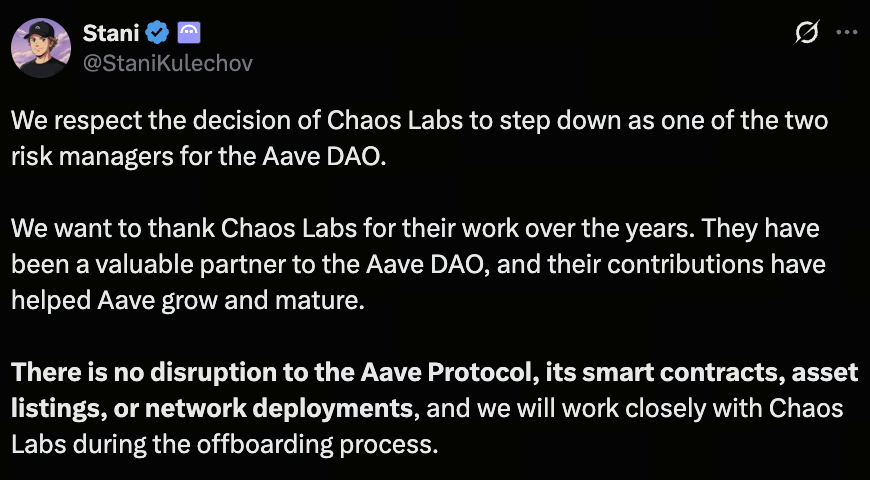
In his April 6, 2026 reply, Stani stated that Aave would not accept several additional conditions proposed by Chaos Labs—including making Chaos the sole protocol risk provider, granting its treasury product default exclusivity in Aave’s B2B business, and expanding its price oracle role in new deployments. Aave Labs emphasized that a dual risk provider model is more robust than a single-provider setup, and better serves the protocol’s decentralization and institutional credibility needs.
In the same thread, LlamaRisk publicly stated that it has served Aave for two years, contributing to the risk framework, parameter design, and quantitative model development for V3, V4, and Horizon, and is ready to fill all operational gaps to ensure risk service continuity.
Short-term, this means Aave is not “flying blind.” LlamaRisk is not a last-minute outsider, but a deeply involved, established risk provider in Aave’s ecosystem.
However, continuity does not mean equivalence.
The hardest part of risk management to replace is not the mathematical models, but the operational experience, cross-chain coordination, anomaly detection, and execution synergy built up over time. For leading DeFi lending protocols, critical risk-handling skills come from “operational knowledge” gained through multiple market cycles—something that cannot be instantly transferred in a single handoff.
So, more accurately: LlamaRisk is capable of maintaining short-term operations, but whether it can match the system-level expertise Chaos Labs built over years remains to be seen.
Why Did This Happen Right After Aave V4 Launched?
Because Aave’s team changes are happening not during a period of stasis, but as the protocol enters a new upgrade cycle. In other words, the risk comes not only from “personnel departures,” but also from “system upgrades.”
According to the official Aave governance forum, Aave V4 was executed by governance and launched on Ethereum mainnet on March 30, 2026. In its April 1, 2026 development update, Aave Labs emphasized that V4 marks a new era for the protocol, with a brand-new architecture and roughly 345 days of cumulative security review—including manual audits, formal verification, invariant testing, fuzz testing, and public security competitions—supported by a $1.5 million security budget.
Architecturally, V4’s most significant change is the hub-and-spoke model. The goal is to retain unified liquidity depth while enabling more granular risk isolation and parameter control across different lending environments and credit structures. For Aave, this is a new path aiming to maintain economies of scale while boosting market expansion capabilities.
The strategic rationale is clear:
- V4 aims to solve liquidity fragmentation caused by traditional multi-market expansion;
- V4 creates more room for complex asset classes, credit markets, and institutional products;
- V4 transforms Aave from just a lending protocol into a platform for broader on-chain credit infrastructure.
Conversely, the more platform-level the upgrade, the more it relies on mature risk, development, and governance teams working in concert.
Chaos Labs emphasized in its departure statement that migrating from V3 to V4 does not halve the workload—V3 won’t disappear overnight, and V4 will require ongoing validation during operation. For a significant period, both systems must be managed in parallel, effectively doubling the risk management burden.
That’s why the overlap of these personnel changes with the V4 launch has truly unsettled the market.
Aave’s Recent Upgrades Go Beyond V4
If this moment is seen solely as a security team resignation, the perspective is too narrow.
Aave’s 2026 agenda is a comprehensive upgrade roadmap, and Chaos Labs’ departure is particularly sensitive because it occurred at a crucial juncture.
-
Aave V4 Official Launch This is the core step. Aave is attempting to evolve from a “mature lending protocol” into “next-generation on-chain credit infrastructure.” The conservative V4 rollout shows Aave Labs understands this upgrade cannot be rushed—it must operate with low caps, low exposure, and gradual scaling.
-
Aave Pro Launch Released alongside V4, Aave Pro is a new interface tailored for the V4 era. This is not just a front-end refresh; it’s a re-alignment of the protocol’s product and user layers to match the new architecture. It signals Aave’s intent to package new protocol capabilities directly into the user experience, not just as a backend upgrade.
-
Horizon Expansion: Aave Bets on Institutionalization and RWA Beyond V4, Aave’s other clear focus is Horizon. In official proposals and weekly reports, Horizon is positioned as a key extension for institutional and RWA scenarios, with some revenue flowing back to the DAO. Aave DAO’s financial analysis notes that swap revenue from aave.com and new income from the Horizon Reserve Factor could add roughly $11.5 million per year to the DAO. This is significant because it shows Aave is no longer content to be just a DeFi lending leader—it aims to integrate protocol income, product revenue, institutional use cases, and brand assets into a broader commercial loop.
-
The “Aave Will Win” Framework Exposes Governance and Interest Distribution Disputes In February 2026, Aave Labs proposed the Aave Will Win Framework, aiming to make V4 the technological core for Aave’s future, direct branded product revenue to the DAO treasury, and establish a new budget framework for strategic growth and development. From a business perspective, this is a more aggressive “protocol corporatization” strategy: upgrading the protocol, consolidating product revenue, and pushing institutional business and brand integration. From a governance perspective, this is where controversy arises. It means Aave Labs’ influence over product, development, branding, and execution is increasing. The consecutive departures of BGD, ACI, and Chaos Labs all reflect this shift.
The Real Challenge for Aave: Governance and Checks and Balances
Some may see that V4 has passed extensive audits, Aave Pro is live, and LlamaRisk is stepping in, and conclude the problem is “technically solved.”
But DeFi history shows that what brings leading protocols to crisis is rarely a single code bug—it’s governance imbalance, overlapping responsibilities, misaligned incentives, and weakened checks and balances.
Aave’s stability has come not just from strong code or scale, but from a mature “layered collaboration structure”:
- Independent technical contributors for development
- Independent risk providers for risk control
- Independent promoters for governance
- Dedicated service providers for finance and growth
The value of this structure is easy to overlook in a bull run, but in extreme market conditions, liquidation waves, and black swan events, it’s what determines whether a protocol survives.
Now, Aave’s risk lies in this structure being reshaped.
If Aave Labs leads protocol development, deeply intervenes in risk transitions, and controls the brand and product revenue framework, the market’s main concern is not “can Labs execute,” but who checks Labs’ power, who provides independent judgment, and who can say no at critical moments.
For a protocol aiming to capture institutional flows, RWA assets, and more complex credit products, independence and checks and balances are fundamental to security.
Is Aave Still Worth Watching?
The answer is not simply bullish or bearish. Aave has entered a phase that demands “layered assessment.”
Short-term, Aave remains one of the most resilient protocols in DeFi lending. V3 is running smoothly, V4 is live, and LlamaRisk is a deeply involved, experienced provider. The protocol will not face systemic interruption due to a resignation alone.
Mid-term, Aave’s key metrics will shift from TVL and revenue to deeper questions:
- Can V4’s risk parameters be expanded stably?
- Will more anomalies emerge during the V3 and V4 parallel period?
- Can LlamaRisk successfully take over all risk operations?
- Will the DAO introduce new, independent risk providers?
- Will the power boundary between Aave Labs and the DAO become even more blurred?
Long-term, Aave could remain a cornerstone of DeFi credit infrastructure—especially if V4, Horizon, and institutionalization all succeed. But it must prove it’s not “expanding protocol capabilities while weakening checks and balances.”
For any DeFi protocol, growth can be driven by product, valuation by narrative—but surviving bear markets and black swans comes down to organizational structure and risk control culture.
The most important question for Aave today isn’t “will Chaos Labs’ departure cause immediate trouble,” but whether, when the next black swan hits, Aave can still rely on a sufficiently independent, professional, and experienced system to keep risk out of sight for users.
That’s the answer the market truly cares about.
Related Articles

In-depth Explanation of Yala: Building a Modular DeFi Yield Aggregator with $YU Stablecoin as a Medium

The Future of Cross-Chain Bridges: Full-Chain Interoperability Becomes Inevitable, Liquidity Bridges Will Decline

Solana Need L2s And Appchains?

Sui: How are users leveraging its speed, security, & scalability?

Navigating the Zero Knowledge Landscape
