CFTC Releases First Guidance on Prediction Market Manipulation Risks: How Will It Reshape Industry Rules?
I. Background: CFTC Issues Guidance on Prediction Market Manipulation Risks
The US Commodity Futures Trading Commission (CFTC) has recently released a guidance document on manipulation risks in prediction markets, marking the first systematic regulatory discussion of prediction market manipulation in the United States.
Prediction markets are financial mechanisms that let users trade on the outcomes of future events, such as:
- Election results
- Macroeconomic data
- Sports outcomes
- Technology or business events
Users typically trade event contracts in a "yes/no" format, with contract prices reflecting the market's view of the probability of an event occurring.
Over the past few years, these markets have expanded rapidly worldwide—especially with the rise of blockchain and crypto technologies—spurring the emergence of new platforms like Kalshi and Polymarket.
As trading volumes and user numbers have soared, regulators have grown concerned about the potential for manipulation or abuse. In response, the CFTC has issued its first guidance focused on prediction market manipulation risks.
II. Key Points of the Guidance: Preventing Manipulation in Prediction Markets
The CFTC's document is a set of regulatory principles rather than formal rules, but it outlines several critical regulatory directions.
-
Event Contracts Must Not Be "Easily Manipulated"
The CFTC highlights a central principle: prediction market contracts must be designed to avoid being "easily manipulated." This typically means traders should not be able to influence event outcomes at relatively low cost. For example:
- A single entity can directly control the outcome
- Results depend on the actions of a small group of participants
- Information sources are opaque
If participants can directly affect an event's outcome, the contract may not meet regulatory standards.
-
Contracts Must Be Clearly Defined and Verifiable
The foundation of a prediction market is the event definition. If a contract is too vague, it can lead to settlement disputes. For example:
- Clear event definition: "Will Company X release its financial report before a specified date?"
- Vague event definition: "Will Company X perform well?"
Regulators insist that all prediction market contracts must have:
- Clear outcome criteria
- Reliable data sources
- Verifiable event results
Otherwise, market prices lose their value as reference points.
-
Platforms Must Assume Self-Regulatory Responsibilities
The CFTC also emphasizes that prediction market platforms should fulfill regulatory responsibilities similar to those of exchanges.
Key responsibilities include:
- Monitoring for abnormal trading activity
- Investigating potential market manipulation
- Detecting insider trading
- Maintaining trading records for audits
In traditional finance, exchanges serve as the first line of regulatory defense. The CFTC wants prediction market platforms to play a comparable role.
-
Addressing Insider Information and Individual Influence
A major controversy in prediction markets is the use of insider information.
For example:
- Government officials with advance knowledge of policy decisions
- Company employees with early access to major announcements
- Sports insiders with privileged information about games
If such information is used for betting, the market can become distorted.
The CFTC also specifically notes the risk of individual actions influencing event outcomes, such as contracts tied to athlete performance in sports events.
If a participant can directly change an event’s outcome, prediction markets could become tools for manipulation.
III. Why Now? The Rapid Expansion of Prediction Markets
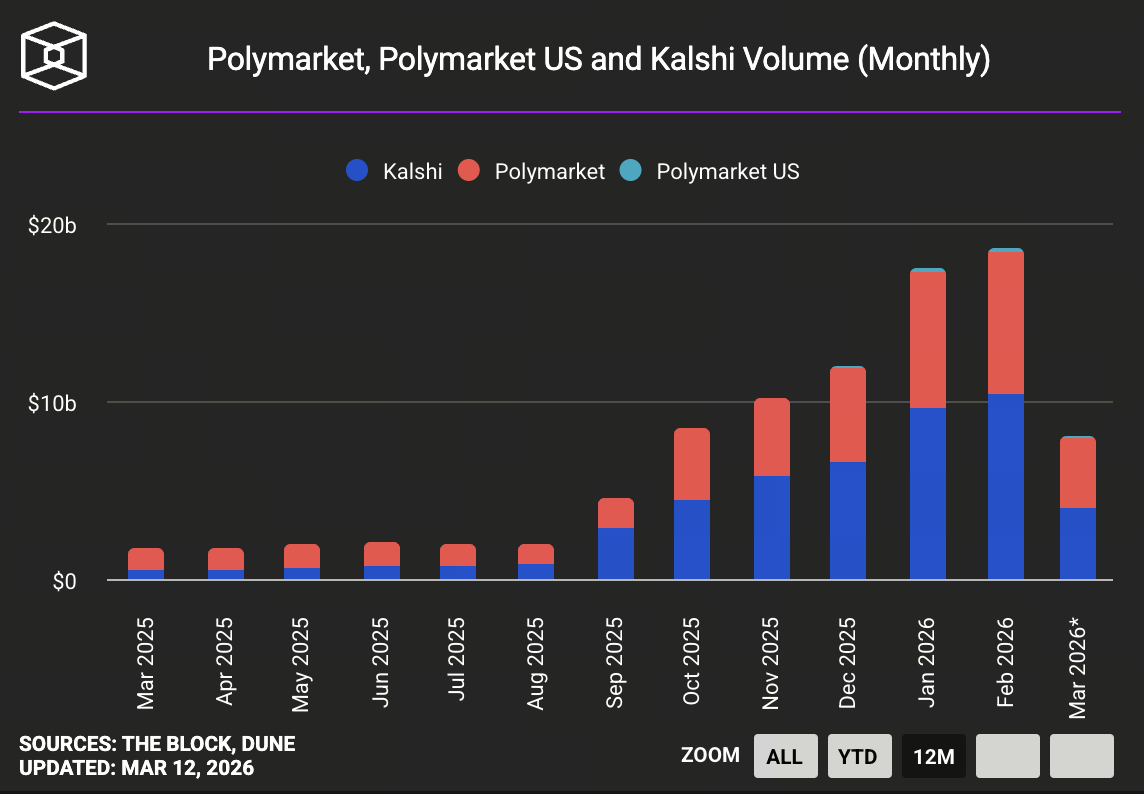 Image source: The Block
The CFTC’s timing is no coincidence; it’s closely linked to the rapid growth of the prediction market sector.
In the past two years, several clear trends have emerged:
1. Rapid Market Growth
Trading volumes on multiple platforms have surged, especially during political and macroeconomic events.
Examples include:
- US election predictions
- Federal Reserve rate forecasts
- Crypto industry event forecasts
These markets have attracted significant speculative capital.
2. Crypto Technology Fuels Decentralized Prediction Markets
Blockchain technology has enabled prediction markets to become global.
On-chain platforms allow users to participate with crypto assets, fueling rapid market expansion.
These platforms typically offer:
- Global user access
- 24/7 trading
- Fewer geographic restrictions
However, this growth also brings regulatory challenges.
3. Sensitive Event Trading Raises Ethical Concerns
Some prediction markets involve sensitive events, such as:
- War risks
- Health of political leaders
- Natural disasters
Regulators worry this type of trading could create ethical issues or even influence real-world behavior. As a result, they are reassessing the regulatory framework for prediction markets.
IV. Regulatory Signals: Prediction Markets Entering a Compliance Phase
While the CFTC’s release is guidance rather than formal regulation, the industry widely sees it as a sign that a regulatory framework for prediction markets is taking shape.
Several changes may be on the horizon:
1. Compliant Platforms Will Gain an Edge
Platforms with regulatory approval, such as Kalshi, may gain a competitive advantage.
This includes:
- Easier access to institutional capital
- Ability to collaborate with regulators
- Lower compliance risk
2. Some Contract Types May Be Restricted
Future regulations may focus on restricting contracts involving:
- Individual actions
- Events that could impact public safety
- Markets that are easily manipulated
3. Market Surveillance Will Tighten
Prediction market platforms may need to implement more robust systems, such as:
- Real-time trade monitoring
- Anti-manipulation algorithms
- Compliance audit mechanisms
This will move prediction markets closer to the regulatory models of traditional financial markets.
V. Potential Industry Impact: Platforms, Users, and the Crypto Market
The CFTC’s new guidance will affect not only prediction markets but could also have ripple effects across the crypto industry.
First, regulatory clarity may attract more institutional participants to prediction markets.
Second, some decentralized platforms may face heightened regulatory pressure.
Finally, prediction markets may evolve into a new form of information market, with prices reflecting not just speculative sentiment but also serving as key indicators for economic forecasting.
VI. Future Trends: Will Prediction Markets Become Core Financial Infrastructure?
Historically, prediction markets have been seen as financial tools that aggregate information. Many economists believe market prices are often more accurate than expert forecasts. If a mature regulatory framework emerges, prediction markets could take on additional roles, such as:
- Policy expectation indicators
- Macroeconomic forecasting tools
- Risk management instruments
Thus, the CFTC’s manipulation risk guidance is not just a regulatory action—it could be a major step toward integrating prediction markets into mainstream finance.
Summary
The CFTC’s release of its first guidance on prediction market manipulation risks signals the start of systematic regulation of the sector in the United States. As trading volumes and market influence grow, prediction markets are likely to enter a more rigorous compliance phase. For the industry, this presents both regulatory challenges and a unique opportunity to move into mainstream financial systems.
Related Articles

AI-Native Settlement Layers: How United Stables Is Building the Next Financial Rail

The ve(3,3) Flywheel Explained: How AERO Tokenomics Powers Aerodrome’s DeFi Economy

How Does PAXG Work? In-Depth Overview of the Physical Gold Tokenization Mechanism

Aerodrome Tokenomics: How ve(3,3) Powers Base's Most Profitable DEX

How is the price of PAXG determined? Pegging mechanism, trading depth, and influencing factors
