BAS vs EAS: What's the Difference Between the BNB and Ethereum Attestation Services?
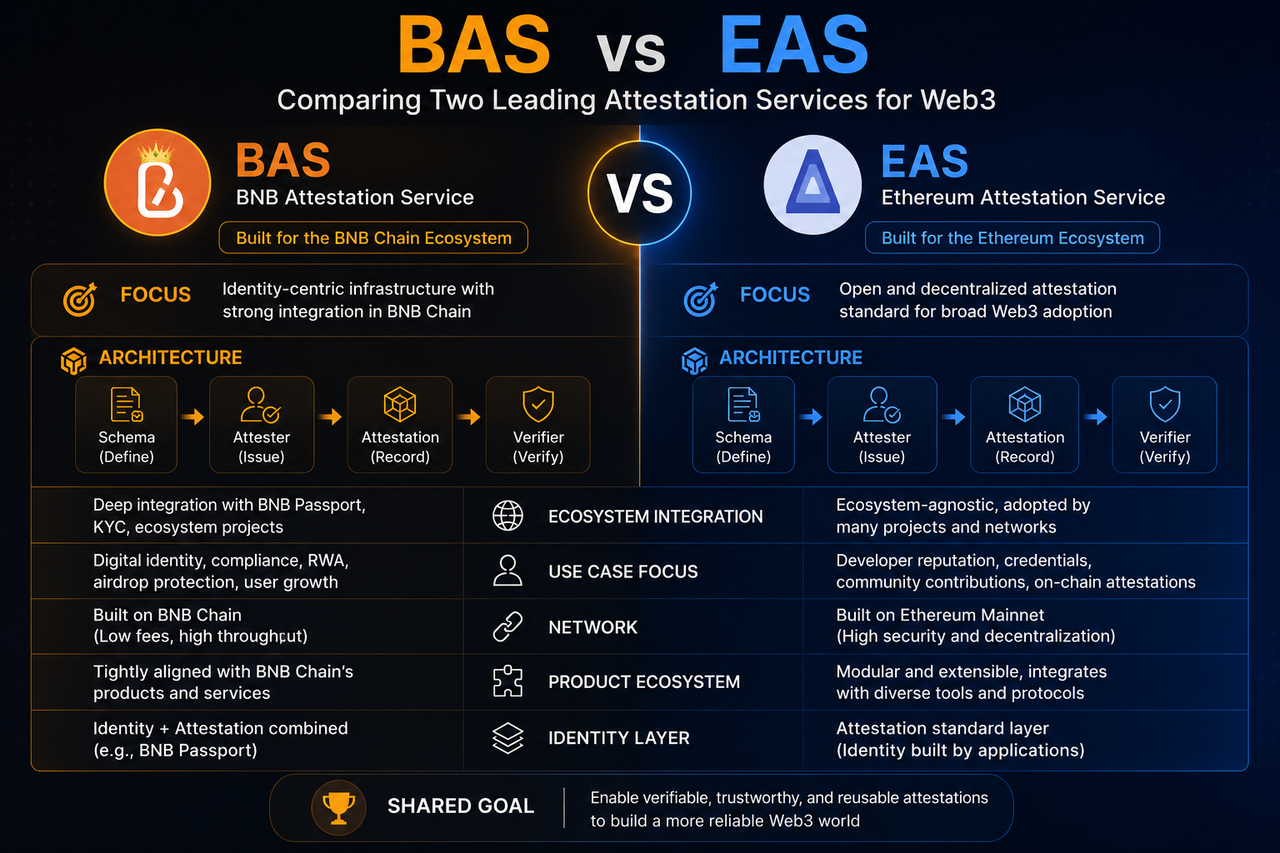
BAS (BNB Attestation Service) and EAS (Ethereum Attestation Service) are both infrastructure protocols for creating, storing, and verifying on-chain attestations. However, they differ significantly in ecosystem positioning, application focus, and expansion strategy. EAS originated within the Ethereum ecosystem, emphasizing open standards and cross-ecosystem interoperability, while BAS is built around the BNB Chain, focusing on digital identity, BNB Passport, compliance certification, and Web3 user growth use cases.As Web3 evolves from an asset network to an identity and data network, verifying off-chain information, building digital reputation, and enabling trusted data sharing have become critical challenges for the blockchain industry. Attestation infrastructure has emerged to address these needs, transforming real-world identities, credentials, and behavioral records into verifiable on-chain proofs.
Today, the two most representative attestation systems are the Ethereum Attestation Service (EAS) within the Ethereum ecosystem and the BNB Attestation Service (BAS) within the BNB Chain ecosystem. Both aim to become foundational components of the Web3 trust layer, but their differing ecosystem contexts and development goals have led to distinct design philosophies and application priorities.
What Is BAS?
BNB Attestation Service is an on-chain attestation infrastructure developed by BNB Chain for creating, managing, and verifying digital proofs.
BAS's core objective is to help developers, institutions, and users build trusted data networks. Through a standardized attestation framework, information such as identity verification, KYC results, DAO membership, enterprise credentials, and on-chain behavioral records can all be transformed into verifiable proofs.
What Is EAS?
Ethereum Attestation Service (EAS) is an open attestation protocol launched on the Ethereum ecosystem.
EAS aims to provide developers with a unified attestation standard, enabling various types of claims to be recorded, shared, and verified. Its design philosophy is to build a general-purpose attestation infrastructure rather than optimizing for specific application scenarios.
Within the EAS ecosystem, developers can create a wide range of attestations, including educational credentials, on-chain reputation, developer contribution records, community identities, and real-world documents.

What Do BAS and EAS Have in Common?
At their core, both BAS and EAS are attestation infrastructures.
Both use standardized data structures to record trusted claims and allow third parties to verify their authenticity. Both are built around key roles such as Schema, Attester, Recipient, and Verifier.
Both systems aim to solve the same fundamental challenge: mapping real-world facts and credentials onto blockchain networks so that this information can be reused across different applications.
Conceptually, BAS and EAS share highly aligned goals, and both are essential components of the Web3 trust layer.
How Do the Ecosystem Positions of BAS and EAS Differ?
Ecosystem positioning is one of the most pronounced differences between the two.
EAS is closer to a general-purpose infrastructure, aiming to become the attestation standard for the entire Ethereum ecosystem and the broader Web3 landscape. Developers are free to build a wide variety of applications, with EAS itself not prescribing a specific identity system or business direction.
In contrast, BAS is more focused on serving the BNB Chain ecosystem.
Beyond providing an attestation framework, BAS is tightly integrated with BNB Passport, identity verification systems, ecosystem incentive programs, and user growth tools. As a result, BAS leans toward building comprehensive solutions around identity and trust, rather than being a mere underlying protocol.
How Do the Architecture Designs of BAS and EAS Differ?
Technically, the two architectures are highly similar.
Both BAS and EAS use a Schema mechanism to define attestation structures, have attesters issue attestations, and rely on verifiers to complete the verification process.
However, differences emerge at the ecosystem integration level.
EAS emphasizes protocol-layer standardization, aiming to become a shared base protocol for various applications. Its design is therefore more open and flexible, allowing developers to freely extend different attestation models as needed.
BAS, on the other hand, adds more application-layer capabilities for identity systems on top of the protocol layer, enabling it to directly support digital identity and credential management use cases.
In short, EAS functions more as a fundamental standard, while BAS is closer to a combination of standard and application ecosystem.
How Do BAS and EAS Differ in Digital Identity?
Digital identity is one of the clearest differentiators between the two.
EAS can support identity attestations, but its primary role is to provide an attestation framework. Identity systems typically need to be built by third-party projects or applications independently.
BAS, however, makes identity systems a core development priority.
Through deep integration with BNB Passport, BAS can consolidate KYC information, on-chain behavioral records, DAO identities, and other identity credentials into a unified digital identity profile.
This model gives BAS stronger ecosystem integration capabilities in identity verification and credential management.
How Do BAS and EAS Support On-chain Reputation Systems?
On-chain reputation is a key use case for attestation technology.
In the EAS ecosystem, developers can build contribution systems, developer reputation systems, or community reputation networks based on attestation records. Because of its high openness, different projects can freely design their own reputation models.
BAS also supports on-chain reputation systems but tends to combine reputation with identity. For example, users' certification records, community contributions, and historical behavioral data can all be incorporated into a unified identity framework.
Thus, EAS emphasizes open reputation networks, while BAS emphasizes identity-driven reputation systems.
How Do the AI Agent Ecosystem Potentials of BAS and EAS Differ?
As AI Agents become important participants in the Web3 ecosystem, attestation technology is increasingly used to establish agent identities and reputation systems.
EAS provides an open attestation framework, allowing developers to create various forms of identity and behavioral records for agents. This makes EAS highly flexible for open experimentation and innovative scenarios.
BAS, in contrast, integrates more naturally with identity management systems.
Through digital identities, reputation records, and credential systems, BAS can help agents build long-term identity profiles and support cross-application collaboration. This model is highly suited for identity management in the future Agent Economy.
What Are the Use Case Differences Between BAS and EAS?
While both support identity verification, DAO governance, and on-chain reputation systems, their application focuses differ.
EAS is better suited for building open attestation networks, developer reputation systems, and cross-ecosystem credential applications. Its value lies in providing a standardized framework that enables various innovative projects to develop based on a unified protocol.
BAS is more applicable to scenarios such as digital identity management, KYC certification, ecosystem growth initiatives, RWA identity verification, and AI Agent reputation systems. Thanks to its deep integration with the BNB Chain ecosystem, its path to real-world deployment is more clearly defined.
BAS vs EAS Comparison
| Dimension | BAS | EAS |
|---|---|---|
| Full Name | BNB Attestation Service | Ethereum Attestation Service |
| Ecosystem | BNB Chain | Ethereum |
| Core Positioning | Identity and trust infrastructure | General-purpose attestation standard |
| Architecture Model | Protocol + identity application ecosystem | Open protocol framework |
| Digital Identity Support | Strong | Moderate |
| Identity Product Integration | BNB Passport | Relies on third-party projects |
| Ecosystem Goal | BNB Chain trust layer | Ethereum general-purpose attestation layer |
| RWA Support | Strong | Strong |
| AI Agent Scenario | Identity-oriented | Openness-oriented |
| Developer Freedom | Relatively high | Higher |
Will BAS Replace EAS?
BAS and EAS are not in a competitive replacement relationship.
They serve different ecosystems and are both built on the same foundational attestation philosophy. As the Web3 trust layer continues to evolve, it is more likely that multiple attestation networks will coexist.
For developers, choosing between BAS and EAS depends more on the target ecosystem and application needs than on one being inherently superior to the other.
In the future, with the development of cross-chain identity and cross-chain reputation systems, different attestation networks may even achieve interoperability and data sharing.
Summary
Both BAS and EAS are critical attestation infrastructures in the Web3 space. Their core mission is to convert real-world identities, credentials, and behavioral records into verifiable on-chain proofs. They share a high degree of similarity in basic architecture, but differ significantly in ecosystem positioning and development direction.
EAS prioritizes open standards and universal protocols, aiming to become the attestation layer for the Ethereum ecosystem and the broader Web3 world. BAS, on the other hand, emphasizes digital identity and trust system construction, building a complete identity ecosystem through integration with applications like BNB Passport.
FAQs
What is the core difference between BAS and EAS?
The biggest difference lies in ecosystem positioning. EAS emphasizes open standards and universal protocols, while BAS emphasizes digital identity and ecosystem application integration.
Can EAS be used for digital identity?
Yes. EAS supports identity attestations, but identity systems typically need to be built by third-party projects on their own. In contrast, BAS is already deeply integrated with identity products like BNB Passport.
Is BAS compatible with the Ethereum ecosystem?
BAS primarily serves the BNB Chain ecosystem, but attestation itself is an open concept, and cross-chain verification and interoperability may become possible in the future.
Is AI Agent more suitable for BAS or EAS?
Both can support AI Agent identity and reputation systems. EAS offers greater openness, while BAS emphasizes integration with digital identity frameworks, making each suitable for different types of agent network needs.
Related Articles

What Is Ethereum 2.0? Understanding The Merge

Our Across Thesis

Reflections on Ethereum Governance Following the 3074 Saga

What is Neiro? All You Need to Know About NEIROETH in 2025

What is Polygon 2.0 (POL)? From MATIC to POL (2025)