Axelar vs LayerZero: What’s the Difference Between Two Cross-Chain Interoperability Protocols?
As the blockchain industry gradually evolves from single-chain structures into a multichain ecosystem, liquidity and applications across different blockchains have become increasingly fragmented. Ethereum, Layer2, Cosmos, Solana, and appchains have each formed their own ecosystems, yet these chains usually cannot communicate with one another directly.
Early cross-chain bridges were mainly used for asset transfers, such as moving tokens from Ethereum to another chain. However, as Web3 applications have become more complex, simple asset bridging is no longer enough for developers. More applications now need cross-chain smart contract calls, interchain state synchronization, and unified liquidity management.
Against this backdrop, cross-chain interoperability protocols have gradually become an important part of Web3 infrastructure. The market is looking for a communication layer similar to an “internet of blockchains,” allowing different networks to interact much like internet servers.
Axelar and LayerZero Overview and Key Differences
As a decentralized cross-chain interoperability network, Axelar enables message and asset communication between different blockchains through an independent PoS validator network. Axelar’s core mechanism is General Message Passing (GMP), which allows developers to call smart contracts directly across different blockchains. Compared with traditional bridging protocols, Axelar places greater emphasis on “cross-chain application coordination,” rather than token transfers alone.
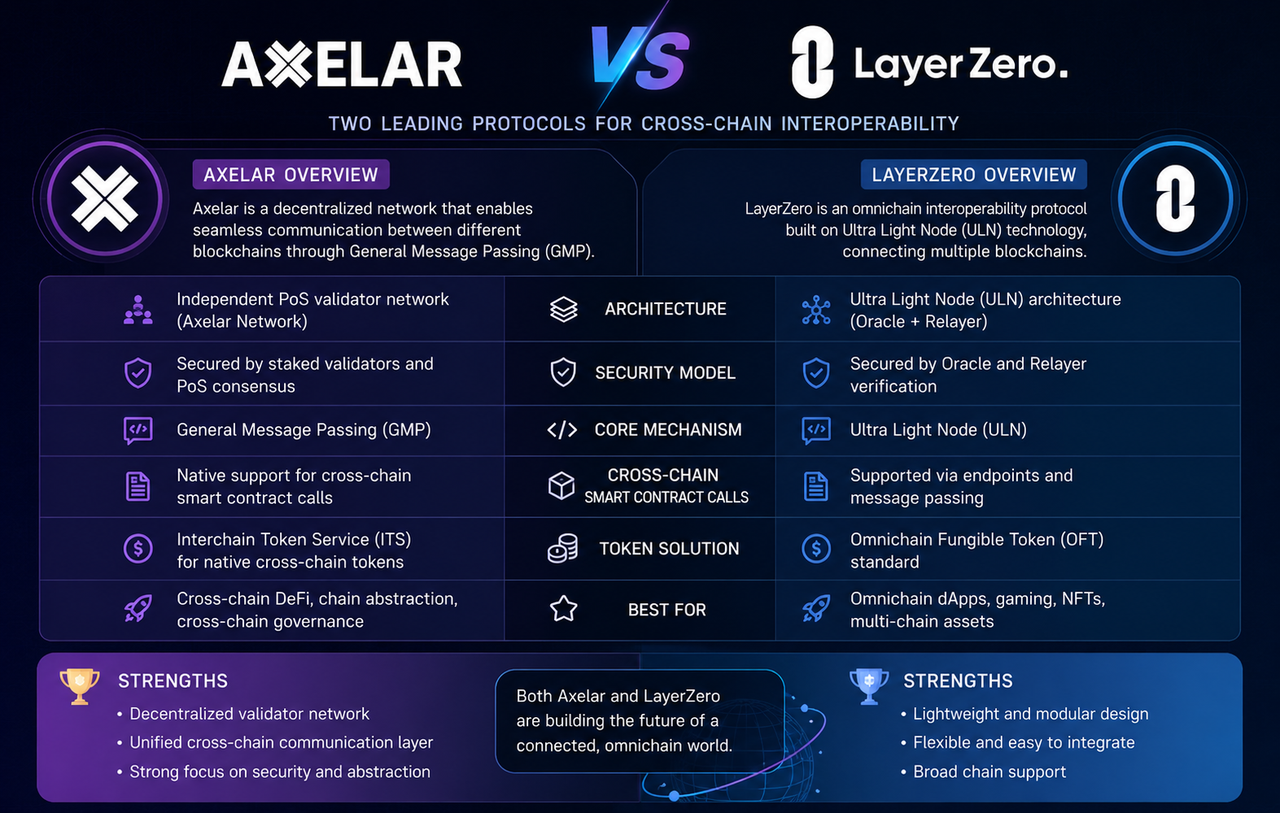
As an omnichain messaging protocol, LayerZero is designed to support lightweight communication between different blockchains. LayerZero’s core architecture is the Ultra Light Node (ULN). Unlike a full light node, a ULN does not store complete block header data on-chain. Instead, it relies on an Oracle and a Relayer to provide block proofs and transaction proofs separately.
| Comparison Dimension | Axelar | LayerZero |
|---|---|---|
| Core positioning | Decentralized cross-chain communication network | Omnichain messaging protocol |
| Core mechanism | General Message Passing (GMP) | Ultra Light Node (ULN) |
| Validation method | Independent PoS validator network | Dual validation by Oracle + Relayer |
| Security model | Based on validator staking and PoS consensus | Based on modular message validation |
| Decentralization approach | Network-level shared security | Configurable security structure |
| Independent chain | Yes, Axelar Network | No independent main chain |
| Cross-chain token solution | ITS (Interchain Token Service) | OFT (Omnichain Fungible Token) |
| Developer experience | More focused on a unified communication layer and APIs | More focused on modularity and customization |
| Suitable scenarios | Chain abstraction, cross-chain DeFi, cross-chain governance | Omnichain games, NFTs, multichain assets |
How Do Axelar and LayerZero Differ in Their Validation Mechanisms?
The validation mechanism is one of the most important differences between the two protocols.
Axelar uses an independent PoS validator network to maintain cross-chain security. Validators are required to stake AXL tokens and jointly confirm the authenticity of cross-chain events. This means Axelar’s security comes from its own validator network.
LayerZero uses a dual validation model based on Oracle and Relayer. The Oracle provides block header data, while the Relayer provides transaction proofs. When the data from both sides matches, the message can be verified.
From a design perspective, Axelar leans more toward a “shared validation network,” while LayerZero leans more toward a “modular validation architecture.”
How Are Axelar and LayerZero Different in Cross-Chain Messaging Architecture?
Axelar’s cross-chain communication mainly revolves around GMP, with the goal of enabling cross-chain smart contract calls and interchain state synchronization.
Developers can use Axelar to send complex messages between different blockchains and trigger smart contract execution logic on the destination chain. As a result, Axelar is better suited to cross-chain DeFi, interchain governance, and chain abstraction applications.
LayerZero, by contrast, places more emphasis on message transmission itself. Developers can build omnichain applications based on its Endpoint and freely define message validation logic.
Put simply, Axelar is more like a “cross-chain communication network,” while LayerZero is more like a “cross-chain messaging protocol framework.”
How Do Axelar and LayerZero Differ in Their Security Models?
The security model is one of the most closely watched parts of any cross-chain protocol.
Axelar’s security depends on its PoS validator network. If validators act maliciously, their staked AXL may be slashed. Its design logic is relatively close to that of a public blockchain network.
LayerZero’s security depends on whether the Oracle and Relayer operate independently. If both are controlled by the same entity, risks may arise. For this reason, LayerZero emphasizes that developers can freely choose different Oracle and Relayer combinations.
In theory, Axelar places more emphasis on a unified security model, while LayerZero places more emphasis on a configurable security architecture.
How Do Axelar and LayerZero Differ in Developer Experience?
Axelar places greater emphasis on unified APIs and cross-chain communication abstraction. Developers can quickly build cross-chain applications through GMP and ITS (Interchain Token Service).
Its development framework is better suited to scenarios that require complex interchain logic, such as cross-chain swaps, cross-chain governance, and chain abstraction wallets.
LayerZero leans more toward a modular development model. Developers can customize cross-chain logic based on Omnichain Fungible Token (OFT) and Endpoint.
As a result, LayerZero is stronger in flexibility, while Axelar stands out more in providing a unified communication experience.
How Do Axelar and LayerZero Differ in Ecosystem Direction?
Axelar has deep connections with Cosmos, multichain DeFi, and the chain abstraction ecosystem. Its main areas of focus include cross-chain communication, cross-chain liquidity, and a unified asset layer.
An ecosystem has already formed around Axelar, including Squid, ITS, and multichain infrastructure.
LayerZero has expanded rapidly in omnichain applications and multichain assets. Many GameFi, NFT, and cross-chain token projects build omnichain applications on LayerZero.
Although both are cross-chain interoperability protocols, their ecosystem development priorities are not exactly the same.
Which Is More Decentralized, Axelar or LayerZero?
There is no absolute answer to this question, because the two protocols define “decentralization” differently.
Axelar’s decentralization is mainly reflected in its independent validator network and PoS consensus mechanism, making its architecture closer to a traditional blockchain network.
LayerZero emphasizes a configurable validation model, allowing developers to choose their own Oracle and Relayer. Therefore, its degree of decentralization partly depends on how developers configure the validation structure.
In practice, the two represent different security and architectural philosophies within cross-chain protocols.
What Use Cases Are Axelar and LayerZero Best Suited For?
Axelar is better suited to scenarios that require complex cross-chain logic and a unified communication layer, such as chain abstraction, cross-chain DeFi, and cross-chain smart contract applications.
LayerZero is better suited to projects that require flexible messaging and omnichain token management, such as omnichain games, NFTs, and cross-chain asset protocols.
Conclusion
Axelar and LayerZero are both important protocols in Web3 cross-chain interoperability, but they follow different technical paths.
Axelar builds a unified cross-chain communication layer through a PoS validator network and GMP, with greater emphasis on cross-chain smart contract calls and interchain application coordination. LayerZero uses Ultra Light Node (ULN) and a modular validation architecture to enable a more lightweight message transmission mechanism.
FAQs
What Is the Difference Between GMP and LayerZero Messaging?
GMP places more emphasis on cross-chain smart contract calls, while LayerZero places more emphasis on lightweight message transmission.
Is LayerZero More Lightweight Than Axelar?
From an architectural design perspective, LayerZero’s ULN model places more emphasis on lightweight validation.
Is Axelar Closer to a Blockchain Network?
Yes. Axelar has an independent validator network and PoS consensus mechanism, making it closer to a cross-chain layer.
Does LayerZero Support Omnichain Tokens?
Yes. LayerZero provides the OFT (Omnichain Fungible Token) model.
Which Protocol Is More Suitable for Chain Abstraction Applications?
Axelar has more extensive development in unified cross-chain communication and chain abstraction, although needs may vary from one project to another.
Related Articles

The Future of Cross-Chain Bridges: Full-Chain Interoperability Becomes Inevitable, Liquidity Bridges Will Decline

Solana Need L2s And Appchains?

Sui: How are users leveraging its speed, security, & scalability?

Navigating the Zero Knowledge Landscape

What is Tronscan and How Can You Use it in 2025?
