As Crypto ETF Momentum Grows, Why Gate ETF Leveraged Tokens Are Becoming a Key Supplement in Trend Markets
Market Changes Driven by the Surge in Crypto ETF Popularity
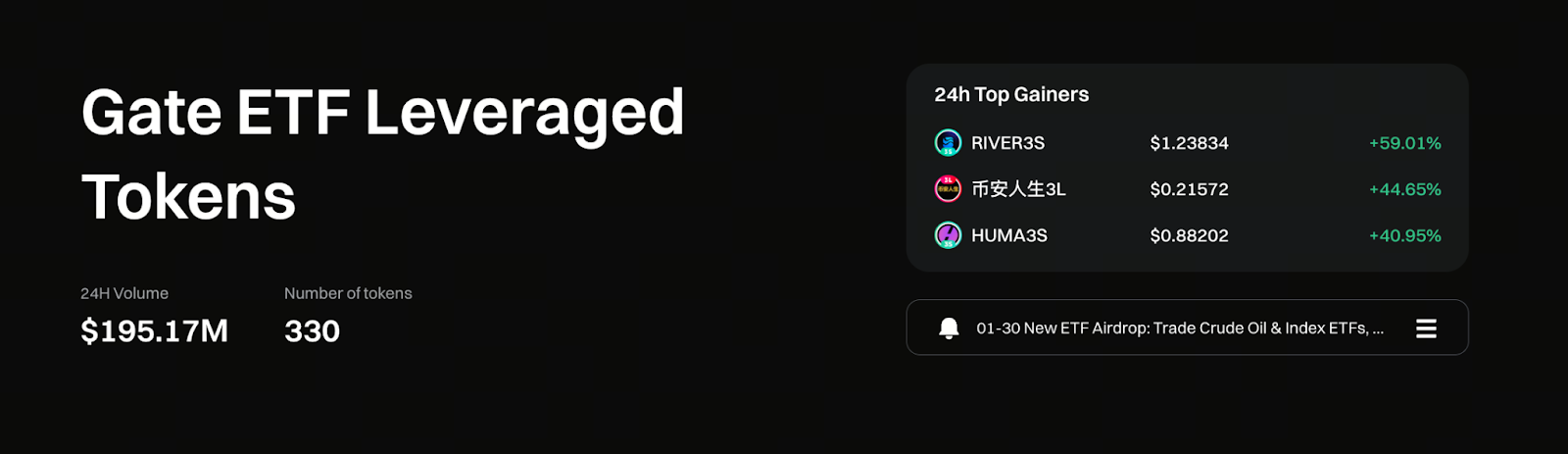
Chart: https://www.gate.com/leveraged-etf
Crypto ETFs have recently dominated market discussions. Whether it’s Bitcoin ETFs, Ethereum ETFs, or debates around ETF compliance, all reinforce one clear signal: capital is flowing into the crypto market in a more structured and deliberate way.
The true value of ETFs extends beyond simply “buying assets.” They lower entry barriers and boost capital efficiency. With this shift, investors are increasingly seeking ways to amplify trend-driven returns—a key reason why Gate ETF leveraged tokens have attracted significant attention.
ETF Structures in the Crypto Market
It’s essential to understand that crypto market ETFs come in multiple forms.
- One type targets traditional financial markets as compliant crypto ETFs, serving mainly as long-term and asset allocation tools;
- The other type is leveraged ETF tokens launched by trading platforms, designed to maximize trading efficiency and market participation.
Gate ETF leveraged tokens belong to the latter category. Unlike conventional index funds, they are structured trading products that offer users fixed-multiple price exposure.
Gate ETF Leveraged Tokens: Design Philosophy
Gate ETF leveraged tokens are designed to let users access leveraged market movements without margin requirements or liquidation risk.
An automatic rebalancing mechanism dynamically adjusts positions to maintain the target leverage. This approach streamlines operations and eliminates forced liquidations during extreme volatility.
From a product perspective, Gate ETF leveraged tokens are not meant for frequent trading. Instead, they serve as efficient tools for users who have already identified a clear market trend.
Gate ETF Leveraged Tokens in Trending Markets
During strong upward or downward trends, Gate ETF leveraged tokens deliver pronounced compounding effects. When the market moves consistently in one direction, automatic rebalancing intensifies the exposure, generating net asset value changes greater than standard spot positions.
This is why leveraged ETF tokens often act as “return amplifiers” in trending markets, but may underperform or even see notable drawdowns in sideways conditions.
As a result, timing the market phase is more important than simply selecting the product.
Rational Participation in Gate ETF Leveraged Token Trading
While Gate ETF leveraged tokens simplify trading, risk management remains essential.
Prudent strategies include:
- Entering after a trend is established, rather than speculating on direction in advance;
- Managing overall position size to avoid excessive concentration in a single product;
- Promptly reassessing holdings if market conditions change.
By treating Gate ETF leveraged tokens as tactical tools for trending markets—not as assets for long-term holding—users can engage with these products more rationally.
Related Articles

AI-Native Settlement Layers: How United Stables Is Building the Next Financial Rail

The ve(3,3) Flywheel Explained: How AERO Tokenomics Powers Aerodrome’s DeFi Economy

How Does PAXG Work? In-Depth Overview of the Physical Gold Tokenization Mechanism

Aerodrome Tokenomics: How ve(3,3) Powers Base's Most Profitable DEX

How is the price of PAXG determined? Pegging mechanism, trading depth, and influencing factors
