AltLayer vs EigenLayer: What’s the Difference Between Restaked Rollups and Restaking Protocols?
As modular blockchains and Rollup scaling continue to grow rapidly, more protocols are exploring shared security mechanisms to reduce network launch costs and strengthen Layer2 security. Against this backdrop, EigenLayer and AltLayer have become important parts of modular infrastructure.
EigenLayer is more of a shared security protocol. Its core goal is to allow already staked ETH to be reused, providing economic security support for other protocols. AltLayer is built on top of this security model and offers a complete Rollup infrastructure through Restaked Rollups, AVS, and Rollup-as-a-Service. Although the two are complementary, they differ clearly in protocol layer, target users, and technical objectives.
What Is EigenLayer?
As an Ethereum-based restaking protocol, EigenLayer allows validators to reuse already staked ETH or liquid staking tokens, known as LSTs, to secure other protocols.
In traditional PoS networks, staked assets are usually used to secure only one chain. EigenLayer’s Restaking model allows the same staked assets to serve multiple protocols at the same time, improving capital efficiency.
The core value of EigenLayer lies in shared security. Through its restaking mechanism, the protocol provides economic security for AVS, or actively validated services.
What Is AltLayer?
As a modular Rollup infrastructure protocol, AltLayer mainly provides Restaked Rollup, AVS, and Rollup-as-a-Service, or RaaS, capabilities.
Unlike EigenLayer, AltLayer does not focus on the underlying restaking protocol. Instead, it is more oriented toward Rollup scaling and appchain deployment frameworks. Developers can use AltLayer to quickly deploy Rollup networks compatible with OP Stack, Arbitrum Orbit, or ZK Stack.
AltLayer’s core objective is to help Rollups gain shared security, fast finality, and decentralized sequencing capabilities.
What Are the Key Differences Between AltLayer and EigenLayer?
The biggest difference between AltLayer and EigenLayer is that they sit at different layers of the modular ecosystem.
EigenLayer is closer to a shared security base layer, providing protocols with restaked economic security. AltLayer is closer to the Rollup infrastructure layer, enhancing Layer2 network capabilities by using AVS and shared security resources.
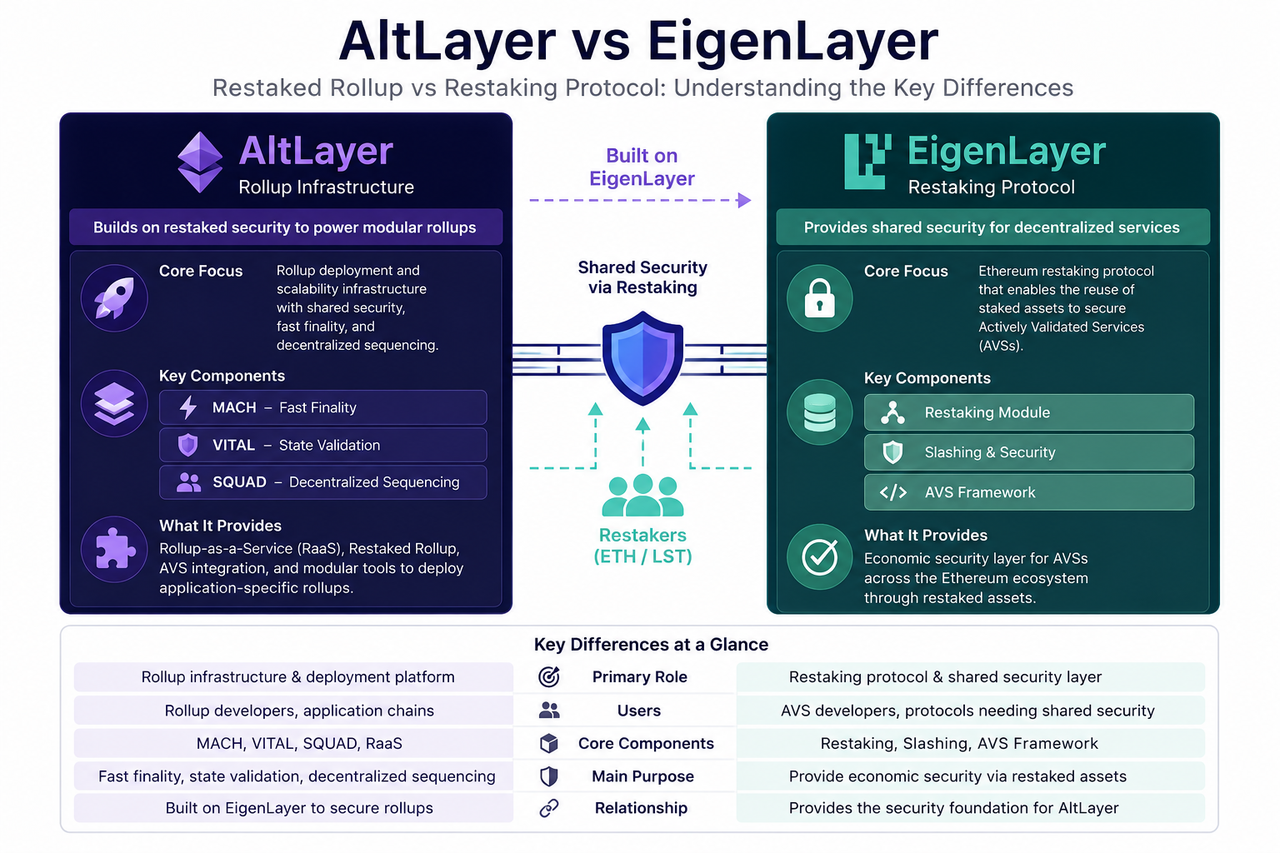
Put simply:
-
EigenLayer provides “shared security”
-
AltLayer uses “shared security” to build Rollup networks
This relationship is similar to the infrastructure layer and application service layer in cloud computing.
What Is the Difference Between Restaking and Restaked Rollups?
Restaking is the shared security mechanism introduced by EigenLayer, while Restaked Rollup is the Rollup architecture built by AltLayer on top of that mechanism.
Restaking focuses on allowing ETH to be reused, providing security support for multiple protocols. Restaked Rollup applies this security model to Rollup networks.
For that reason, the two are not competing concepts. They are part of an upstream and downstream collaborative relationship.
What Role Does AVS Play in Each?
AVS, or actively validated services, is the core component connecting AltLayer and EigenLayer.
In the EigenLayer ecosystem, AVS refers to service networks that require shared security support. Data availability layers, oracles, and verification systems can all exist as AVS.
In AltLayer, AVS is more closely tied to Rollup security components, including services such as MACH, VITAL, and SQUAD.
AltLayer is, in essence, one of the practical application scenarios for AVS.
Why Do MACH, VITAL, and SQUAD Depend on EigenLayer?
AltLayer’s MACH, VITAL, and SQUAD are all AVS services, so they need shared security support.
EigenLayer provides restaked assets and a validator network, while AltLayer’s AVS use these resources to deliver fast finality, state verification, and decentralized sequencing.
Without an underlying shared security layer, AltLayer would need to build a large validator network on its own, which would increase launch costs and maintenance complexity.
Therefore, EigenLayer can be seen as an important foundation for AltLayer’s security model.
How Do Their Roles Differ in Modular Blockchains?
Modular blockchains emphasize separating execution, data availability, consensus, and settlement into different layers.
EigenLayer is closer to a “shared security layer,” functioning much like security middleware in the modular ecosystem.
AltLayer is closer to a “Rollup execution and scaling layer,” mainly responsible for appchain deployment, sequencing, and enhanced Rollup security.
Since the two sit in different parts of the modular blockchain stack, their functions do not overlap.
Are AltLayer and EigenLayer Competitors?
AltLayer and EigenLayer are generally not seen as direct competitors.
EigenLayer aims to provide shared security for a wide range of protocols, while AltLayer is one of the protocols that uses these shared security resources.
From an ecosystem perspective, the two are more like infrastructure collaborators. EigenLayer provides security capabilities, while AltLayer integrates those capabilities into Rollup networks.
How Do the Risk Structures of AltLayer and EigenLayer Differ?
EigenLayer’s main risks are concentrated at the shared security layer. If multiple protocols rely on the same restaked assets at the same time, cascading risks could emerge under extreme conditions.
AltLayer’s risks come more from Rollup architecture, sequencers, cross-chain coordination, and the operational complexity of AVS.
Although the sources of risk are different, AltLayer partly depends on EigenLayer’s security model, so the two are connected to some extent.
Which Use Cases Would Use Both AltLayer and EigenLayer?
On-chain gaming, AI Agents, DeFi, and application-specific Rollups are all scenarios that may use both AltLayer and EigenLayer.
For example, a gaming Rollup could use AltLayer to deploy its network quickly, while also using EigenLayer’s restaked security to improve network credibility.
AI Agent networks may also need fast finality, low latency, and shared security, making this combined architecture a suitable fit.
Conclusion
AltLayer and EigenLayer are both important infrastructure components in the modular blockchain ecosystem, but they serve different roles.
EigenLayer is a shared security and restaking protocol responsible for providing economic security to AVS. AltLayer is a Rollup infrastructure protocol that provides Layer2 networks with fast finality, state verification, and decentralized sequencing through Restaked Rollups, AVS, and RaaS.
The two are not competitors. Instead, they form an upstream and downstream collaborative relationship. EigenLayer provides the shared security foundation, while AltLayer uses these security capabilities to build the next generation of modular Rollup networks.
FAQs
What Is the Difference Between AltLayer and EigenLayer?
EigenLayer is a shared security and restaking protocol, while AltLayer is a modular Rollup infrastructure protocol. They sit at different layers of the ecosystem.
Are Restaking and Restaked Rollups the Same Concept?
Restaking is a restaking mechanism, while Restaked Rollup is a Rollup architecture built by AltLayer using restaked security.
Does AltLayer Depend on EigenLayer?
Some of AltLayer’s AVS and shared security capabilities are built on EigenLayer’s restaking model, so the two have a collaborative relationship.
Can EigenLayer Be Used Independently of AltLayer?
EigenLayer is an independent shared security protocol. It can provide security support for many types of AVS and modular protocols, not only AltLayer.
Do MACH and VITAL Belong to EigenLayer?
MACH and VITAL are AltLayer AVS services, but they use restaked security resources provided by EigenLayer.
Related Articles

In-depth Explanation of Yala: Building a Modular DeFi Yield Aggregator with $YU Stablecoin as a Medium

The Future of Cross-Chain Bridges: Full-Chain Interoperability Becomes Inevitable, Liquidity Bridges Will Decline

Solana Need L2s And Appchains?

Sui: How are users leveraging its speed, security, & scalability?

Navigating the Zero Knowledge Landscape
