Allora vs Bittensor: What Are the Differences Between These Decentralized AI Networks?
As AI and crypto infrastructure continue to converge, decentralized AI networks are gradually expanding from simple computing power markets into data markets, model markets, and inference markets. Allora and Bittensor represent two different development paths. Understanding the differences between them helps build a clearer framework for thinking about Web3 AI infrastructure.
What Is Allora Network?
Allora Network is a decentralized network focused on AI inference and prediction services. Its goal is to improve the accuracy of prediction results through collective intelligence and provide verifiable AI inference capabilities to on-chain applications.
In the Allora network, different AI models provide prediction results around specific Topics. The network dynamically adjusts model weights based on historical performance and uses the ALLO token to incentivize high-quality contributors.
Compared with traditional AI services, Allora places greater emphasis on the transparency, verifiability, and composability of prediction results.
What Is Bittensor?
Bittensor is an open machine learning network that allows different AI models to collaborate and compete through blockchain. Its core goal is to build a decentralized artificial intelligence market where models can share knowledge and earn rewards.
In the Bittensor ecosystem, miners generate AI outputs, while validators assess the quality of those results. The network uses the TAO token to incentivize high-quality models and computing contributors.
Compared with Allora, Bittensor is closer to an open AI production network than a dedicated prediction market.
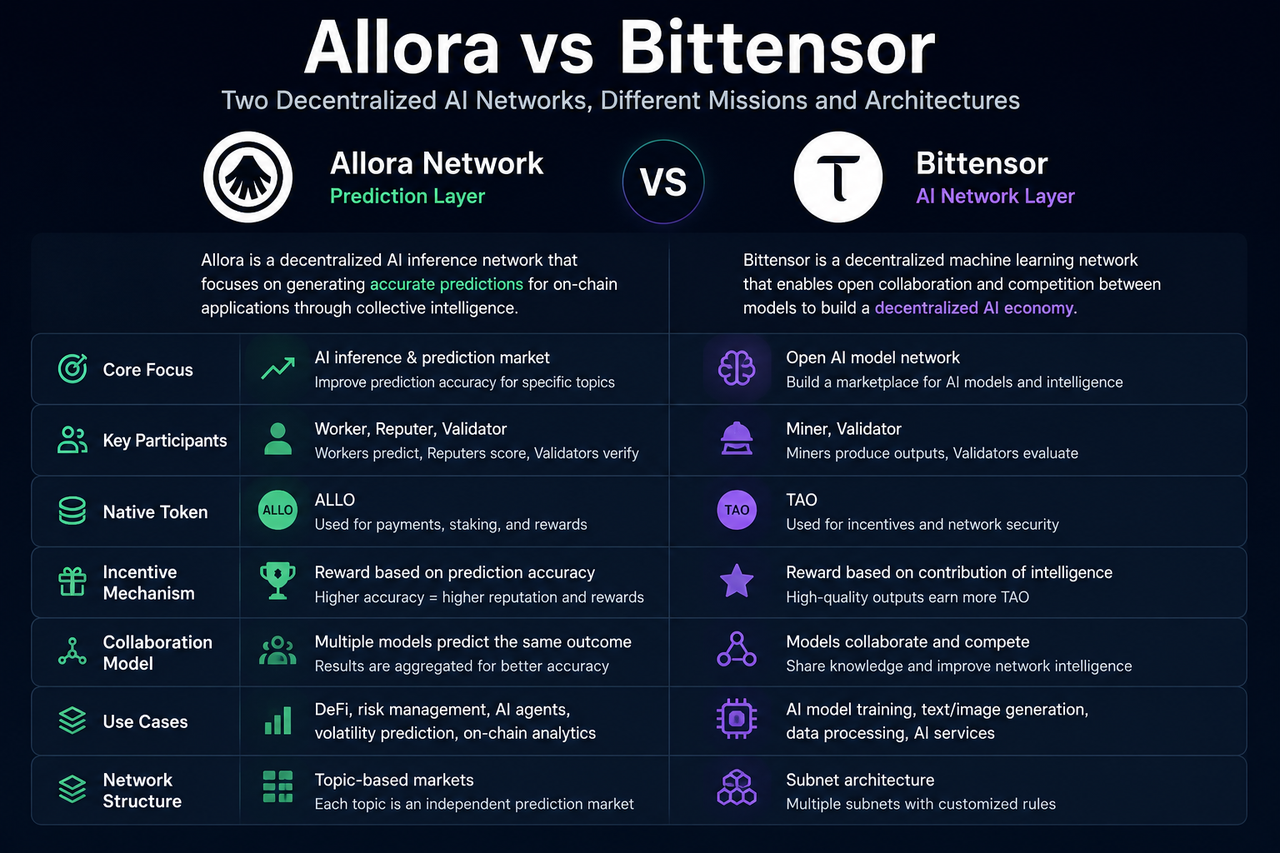
How Do the Core Goals of Allora Network and Bittensor Differ?
The biggest difference between Allora and Bittensor comes from their network goals.
Allora aims to solve the problem of information efficiency, allowing on-chain applications to obtain more accurate prediction results. Its focus is therefore on inference quality and predictive capability.
Bittensor aims to build an open AI economy where different models can share knowledge, exchange value, and form a decentralized artificial intelligence network.
Put simply, Allora cares more about “whether the answer is accurate,” while Bittensor cares more about “who can provide the most valuable intelligence service.”
How Do the Participant Structures of Allora Network and Bittensor Differ?
Both networks use multi-role collaboration, but the responsibilities of their participants are clearly different.
Allora’s Participant Structure
Allora is mainly composed of Workers, Reputers, and Validators.
Workers provide prediction results.
Reputers evaluate prediction accuracy.
Validators verify the scoring and reward process.
The entire system is built around prediction quality.
Bittensor’s Participant Structure
Bittensor is mainly composed of Miners and Validators.
Miners generate model outputs.
Validators evaluate output quality.
Different Subnets can set their own rules based on specific needs.
This structure is better suited to building an open AI service market.
How Do the Incentive Mechanisms of Allora Network and Bittensor Differ?
Incentive design shapes the long-term direction of a network.
Allora uses a reward mechanism based on prediction accuracy. The network adjusts node reputation according to historical performance and distributes rewards to participants that deliver higher-quality predictions.
Bittensor uses a mechanism centered on knowledge contribution. Miners earn rewards by providing valuable AI outputs to the network, while validators evaluate the quality of those contributions.
As a result, Allora is more like a prediction market, while Bittensor is more like an intelligence production market.
How Do AI Models Collaborate in Allora Network and Bittensor?
Both networks emphasize collaborative intelligence, but they collaborate in different ways.
In Allora, multiple models make predictions on the same question. The network aggregates results through a reputation system to produce better predictions.
In Bittensor, models can share knowledge and compete with one another. High-quality models can influence the distribution of knowledge across the entire network.
The former emphasizes prediction aggregation, while the latter emphasizes knowledge sharing.
How Do the Data and Inference Logic of Allora Network and Bittensor Differ?
Allora focuses on whether final prediction results are close to real-world data, so its evaluation standards are usually tied to actual outcomes.
For example, asset price forecasts, market volatility predictions, and risk assessment scenarios can all verify model quality through real results.
Bittensor focuses more on whether model outputs have value, and its evaluation standards vary across different Subnets.
Therefore, Allora’s evaluation system is usually more unified, while Bittensor’s evaluation systems are more diverse.
Which Use Cases Are Better Suited to Allora?
Allora is better suited to scenarios that require predictive capability.
For example:
-
DeFi risk management
-
Volatility prediction
-
AI Agent decision-making systems
-
Automated trading models
-
On-chain data analysis
What these scenarios have in common is the need for continuous access to high-quality prediction results.
Which Use Cases Are Better Suited to Bittensor?
Bittensor is better suited to scenarios that require AI model production capabilities.
For example:
-
Large language model services
-
AI content generation
-
Machine learning research
-
AI data processing
-
Intelligent search systems
These scenarios focus more on the capabilities of the models themselves, rather than a single prediction result.
Allora vs Bittensor Comparison Table
| Comparison Dimension | Allora Network | Bittensor |
|---|---|---|
| Core positioning | AI inference and prediction market | Open AI network |
| Native token | ALLO | TAO |
| Core goal | Improve prediction accuracy | Build a decentralized AI economy |
| Main roles | Worker, Reputer, Validator | Miner, Validator |
| Incentive basis | Prediction performance | Knowledge contribution |
| Collaboration method | Collective prediction | Model collaboration |
| Use cases | DeFi, prediction markets, AI Agents | AI services, model training, content generation |
| Network structure | Topic markets | Subnet system |
| Data verification | Based on real outcome feedback | Based on Subnet evaluation systems |
Allora Network vs Bittensor: Which Model Is Closer to the Future of AI Infrastructure?
Decentralized AI does not follow a single development path.
Allora represents prediction and inference layer infrastructure. Its value lies in providing trusted intelligent data for blockchain applications.
Bittensor represents open AI network infrastructure. Its value lies in building a decentralized model economy.
As the AI ecosystem develops, these two models are unlikely to simply replace each other. They are more likely to become complementary. In the future Web3 AI stack, Bittensor may provide intelligence production capabilities, while Allora provides prediction and inference capabilities. Together, they could form important components of decentralized AI infrastructure.
Conclusion
Allora and Bittensor are both decentralized AI networks, but they focus on different problems. Allora’s core purpose is to build an on-chain prediction and inference market, using collective intelligence to improve prediction quality. Bittensor’s core purpose is to establish an open AI model economy, advancing artificial intelligence through knowledge sharing and competition.
From an infrastructure classification perspective, Allora is closer to a Prediction Layer, while Bittensor is closer to an AI Network Layer. Understanding this distinction helps clarify the development direction and division of value within the decentralized AI ecosystem.
FAQs
Are Allora and Bittensor competitors?
Allora and Bittensor belong to the same decentralized AI sector, but they have different positions. Allora focuses on prediction and inference services, while Bittensor focuses on models and intelligence production. In that sense, the two are more complementary than directly competitive.
What is the biggest difference between Allora and Bittensor?
Allora focuses on generating more accurate prediction results, while Bittensor focuses on building an open AI model network and knowledge market.
What is the difference between ALLO and TAO?
ALLO is mainly used to pay for inference services, support staking, and reward prediction contributors. TAO is mainly used to incentivize model contributors and maintain the operation of the Bittensor network.
Why is Allora called a Prediction Layer?
Allora’s core function is to aggregate prediction results from multiple AI models and continuously improve inference quality, so it is usually classified as AI prediction layer or inference layer infrastructure.
Is Allora or Bittensor more suitable for DeFi projects?
DeFi projects that need market forecasting, risk assessment, and intelligent decision-making are usually better suited to Allora. Projects that need AI model services or content generation capabilities are more suited to Bittensor.
Related Articles

Blockchain Profitability & Issuance - Does It Matter?

Arweave: Capturing Market Opportunity with AO Computer
What Is Substrate? How Polkadot Uses It to Build a Parachain Ecosystem

What Are Polkadot Parachains? How They Enable Cross-Chain Scalability

How Cysic Works? A Detailed Look at Proof-of-Compute and ZK Compute Scheduling