A Decade-Long Debate at a Crossroads: Could Ethereum Finally Put an End to the "Blockchain Trilemma"?
The term "impossible trinity" is probably familiar to everyone in the blockchain community by now.
In Ethereum's first decade, the "impossible trinity" was like a law of physics hanging over every developer—you could choose any two among decentralization, security, and scalability, but you could never have all three at once.
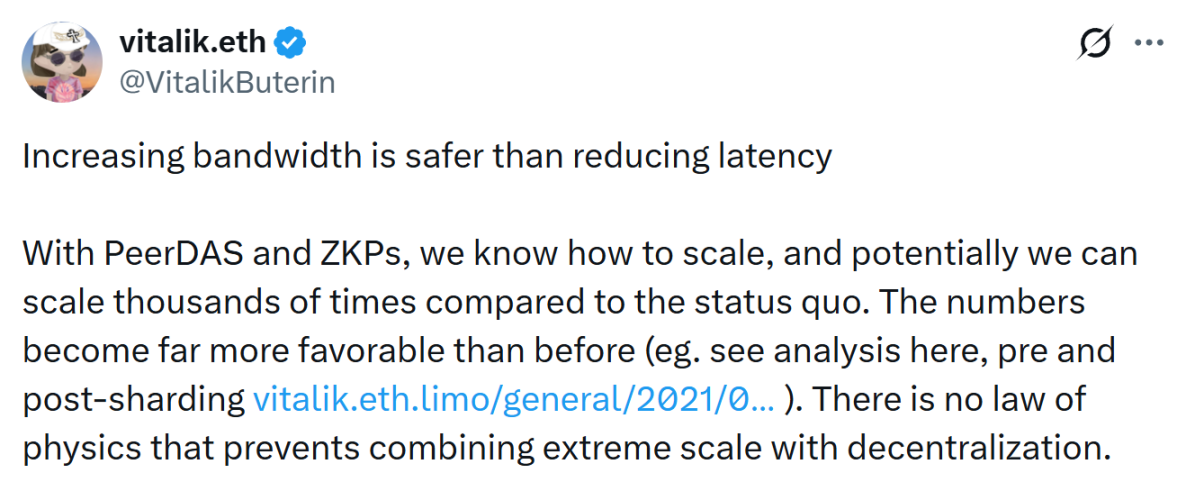
Yet, looking back from early 2026, it's clear that this barrier is gradually transforming into a "design threshold" that technological progress can overcome. As Vitalik Buterin noted in his groundbreaking January 8 remarks, "Compared to reducing latency, increasing bandwidth is safer and more reliable. With PeerDAS and ZKP, Ethereum's scalability can improve by thousands of times without compromising decentralization."
So, can the "impossible trinity"—once considered unbreakable—truly fade away in 2026 as PeerDAS, ZK technology, and account abstraction mature?
I. Why Has the "Impossible Trinity" Been So Difficult to Overcome?
Let's revisit the "blockchain impossible trinity" concept introduced by Vitalik Buterin, which describes the dilemma public blockchains face in balancing security, scalability, and decentralization:
- Decentralization means low node requirements, broad participation, and no need to trust a single authority.
- Security means the system remains consistent even in the face of malicious actors, censorship, or attacks.
- Scalability means high throughput, low latency, and a strong user experience.
The challenge is that, in traditional architectures, these three elements often restrict one another. For example, boosting throughput usually means raising hardware requirements or introducing centralized coordination; reducing node burden can weaken security assumptions; and extreme decentralization often sacrifices performance and user experience.
Over the past 5–10 years, from early EOS to Polkadot and Cosmos, and then to performance-focused chains like Solana, Sui, and Aptos, public blockchains have taken different approaches. Some have sacrificed decentralization for performance, others have used permissioned nodes or committee mechanisms to boost efficiency, and some have accepted limited performance to prioritize censorship resistance and validator freedom.
The common thread is that nearly all scaling solutions could only satisfy two out of three goals, inevitably sacrificing the third.
Put another way, nearly every solution has been stuck in the same "monolithic blockchain" tug-of-war—if you want speed, you need strong nodes; if you want more nodes, you have to slow down. This has seemed like an inescapable dilemma.
If we set aside the debate over monolithic versus modular blockchains and look back at Ethereum's 2020 shift from a "monolithic chain" to a rollup-centric, multi-layer architecture—and the recent maturity of supporting technologies like ZK (zero-knowledge proofs)—we see that:
Ethereum's modular evolution over the past five years has already begun to reconstruct the underlying logic of the "impossible trinity."
Objectively, Ethereum has used a series of engineering practices to systematically decouple these constraints. At least from an engineering perspective, this is no longer just a philosophical debate.
II. "Divide and Conquer": The Engineering Solution
Let's break down these engineering details and see how, between 2020 and 2025, Ethereum has used multiple technical tracks in parallel to address the trilemma.
First, PeerDAS enables the "decoupling" of data availability, removing the natural ceiling on scalability.
It's well known that data availability is the primary bottleneck for scalability in the impossible trinity. Traditional blockchains require every full node to download and verify all data, ensuring security but limiting scalability. That's why DA solutions like Celestia saw explosive growth in previous cycles.
Ethereum's approach is not to make nodes more powerful, but to change how nodes verify data, with PeerDAS (Peer Data Availability Sampling) at the core:
Nodes no longer need to download all block data. Instead, they use probabilistic sampling to check data availability—block data is split and encoded, and nodes only need to randomly sample parts of the data. If data is hidden, the probability of sampling failure rises rapidly. This dramatically increases data throughput while allowing regular nodes to participate in verification. It's not about sacrificing decentralization for performance, but about using mathematics and engineering to optimize verification costs.
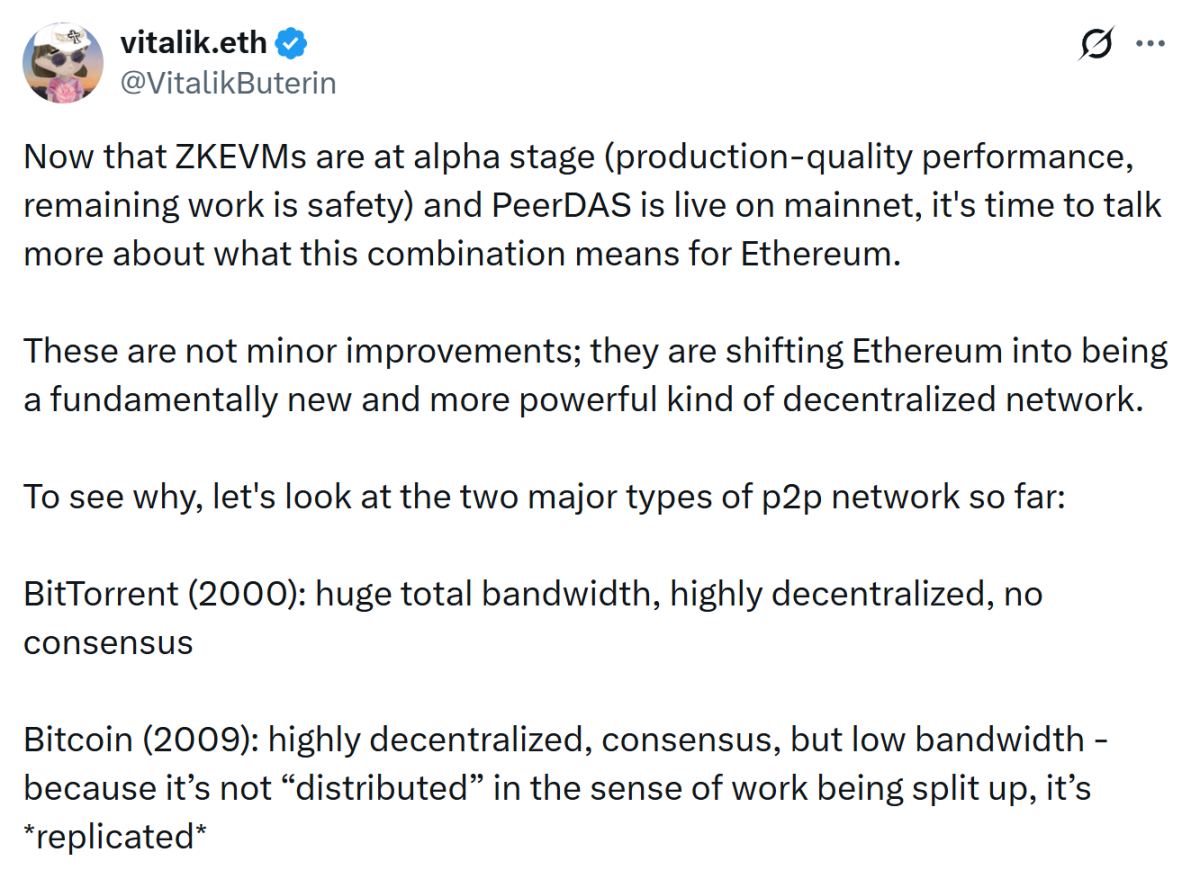
Vitalik emphasized that PeerDAS is no longer just a roadmap proposal but a real, deployed system component. This marks a real step forward for Ethereum in combining scalability and decentralization.
Next is zkEVM, which uses a zero-knowledge proof-driven verification layer to solve the problem of whether every node must repeat all computations.
The core idea is to enable the Ethereum mainnet to generate and verify ZK proofs. After each block executes, it can output a verifiable mathematical proof, letting other nodes confirm correctness without re-executing all computations. zkEVM offers three main advantages:
- Faster verification: Nodes only need to verify the zkProof to confirm block validity, not replay all transactions.
- Lighter burden: It greatly reduces the computational and storage load on full nodes, making it easier for light nodes and cross-chain validators to participate.
- Stronger security: Compared to the OP approach, ZK state proofs are confirmed on-chain in real time, providing higher tamper-resistance and clearer security boundaries.
Recently, the Ethereum Foundation (EF) officially released the L1 zkEVM live proof standard, marking the first time the ZK approach has been formally included in mainnet-level technical planning. Over the next year, Ethereum’s mainnet will gradually transition to an execution environment supporting zkEVM verification, shifting from "heavy execution" to "proof verification."
Vitalik believes zkEVM has reached a production-ready stage in terms of performance and functionality. The real challenges are long-term security and implementation complexity. According to EF’s technical roadmap, block proof latency is targeted below 10 seconds, individual zk proofs are under 300 KB, a 128-bit security level is used, trusted setup is avoided, and even home devices will be able to participate in proof generation, lowering the decentralization barrier.
Finally, Ethereum’s roadmap through 2030 (including The Surge, The Verge, and others) focuses on increasing throughput, restructuring state models, raising gas limits, and improving the execution layer from multiple angles.
These efforts represent iterative steps toward overcoming the traditional trilemma. They form a long-term strategy aimed at higher blob throughput, clearer rollup specialization, and more stable execution and settlement, laying the foundation for future multi-chain collaboration and interoperability.
Importantly, these are not isolated upgrades but are designed as mutually reinforcing modules. This reflects Ethereum’s "engineering approach" to the impossible trinity: not seeking a one-size-fits-all solution like monolithic blockchains, but reallocating costs and risks through multi-layer architecture.
III. The 2030 Vision: Ethereum’s Endgame
Even so, we must remain measured. Elements like "decentralization" are not static technical metrics, but the result of long-term evolution.
Ethereum is methodically testing the boundaries of the impossible trinity through engineering practice. As verification methods (from full re-execution to sampling), data structures (from state bloat to state expiry), and execution models (from monolithic to modular) evolve, the old trade-offs are shifting. We're getting closer to having it all.
Recently, Vitalik outlined a relatively clear timeline:
- 2026: With improvements in execution and construction mechanisms and the introduction of ePBS, gas limits not reliant on zkEVM can be raised, paving the way for broader zkEVM node participation.
- 2026–2028: Adjustments to gas pricing, state structure, and execution payload organization will enable the system to run safely under higher load.
- 2027–2030: As zkEVM gradually becomes the main method for block verification, gas limits may rise further, with the long-term goal of more distributed block construction.
Based on the latest roadmap updates, we can identify three key features of Ethereum by 2030 that together form the ultimate answer to the impossible trinity:
- Minimalist L1: The L1 becomes a robust, neutral base layer responsible only for data availability and settlement proofs, no longer handling complex application logic, which maximizes security.
- Thriving L2 and interoperability: Through EIL (the interoperability layer) and rapid confirmation rules, fragmented L2s are integrated into a cohesive whole. Users no longer perceive the underlying chains—only the resulting high TPS.
- Ultra-low verification threshold: With mature state processing and light client technology, even smartphones can participate in verification, ensuring decentralization remains rock-solid.
Notably, as this article was being written, Vitalik reiterated an important test—the "Walkaway Test"—emphasizing that Ethereum must be able to run autonomously. Even if all server providers disappear or are attacked, DApps must continue to function and user assets must remain secure.
This reframes the evaluation of Ethereum’s "endgame" from speed and user experience back to the core value: whether the system remains trustworthy and free from single points of failure, even in worst-case scenarios.
Final Thoughts
We must approach these issues with a forward-looking perspective, especially in the rapidly evolving Web3 and crypto industry.
The author believes that years from now, when people look back on the heated debates about the impossible trinity from 2020–2025, they'll see it as similar to pre-automobile debates about how carriages could balance speed, safety, and load.
Ethereum’s answer is not to make painful trade-offs between the three endpoints, but to use PeerDAS, ZK proofs, and innovative economic mechanisms to build a digital infrastructure that is open to all, extremely secure, and capable of supporting global financial activity.
Objectively, every step forward is built on the foundation of overcoming the impossible trinity.
Disclaimer:
- This article is reprinted from [TechFlow], with copyright belonging to the original author [imToken]. If you have any concerns about this reprint, please contact the Gate Learn team for prompt handling according to relevant procedures.
- Disclaimer: The views and opinions expressed in this article are those of the author alone and do not constitute investment advice.
- Other language versions of this article are translated by the Gate Learn team. Without mentioning Gate, reproduction, distribution, or plagiarism of the translated article is not permitted.
Related Articles

What Is Ethereum 2.0? Understanding The Merge
Our Across Thesis

Reflections on Ethereum Governance Following the 3074 Saga

What is Neiro? All You Need to Know About NEIROETH in 2025
What is Polygon 2.0 (POL)? From MATIC to POL (2025)