Gold Price Forecast 2026: Can Gold Surge to $5,000? Institutional Targets and Market Analysis
2025 Review and 2026 Outlook: The Bull Market Continues
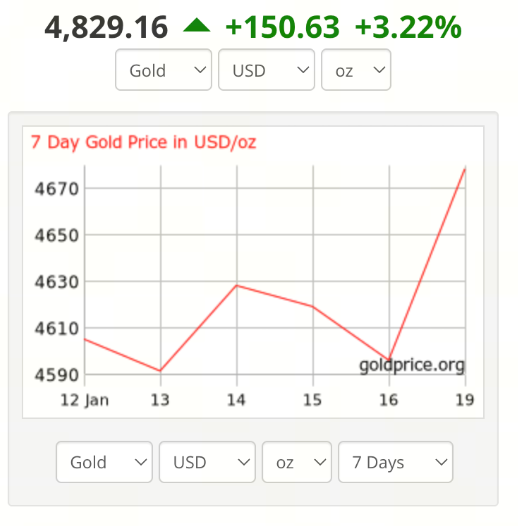
Image: https://goldprice.org/
The gold market posted a strong performance over the past year, with gold prices continually breaking records throughout 2025. By early 2026, spot gold had surged past $4,800 per ounce, underscoring the market’s intense demand for safe-haven assets.
As 2026 opens, leading Wall Street firms and international banks have issued new gold price forecasts. These projections reflect ongoing concerns about global economic uncertainty and reinforce confidence in gold’s long-term value as a critical portfolio diversifier.
Latest Institutional Gold Price Forecasts
Morgan Stanley
The bank expects continued central bank gold purchases, robust gold ETF investment demand, and persistent expectations for lower interest rates to drive gold prices higher in 2026. The firm sees gold potentially reaching $4,500 per ounce in the medium term.
Bank of America
Bank of America’s latest forecast suggests that if investment demand remains strong, gold could climb as high as $5,000 per ounce in 2026. The bank projects an average annual price of about $4,400 and notes that widening fiscal deficits and rising debt will provide long-term support for gold bullion.
UBS
UBS has raised its 2026 gold price target, indicating that escalating political and financial risks could push prices to $5,400 per ounce. If those risks ease, the year-end price may settle around $4,800.
World Gold Council (WGC)
The WGC forecasts that in the most optimistic scenario, gold prices could rise 15%–30% in 2026. In a strong economic growth scenario, however, prices may correct by 5%–20%.
Despite varying figures, the overall trend shows most institutions remain confident in gold’s upside potential.
Key Drivers Behind Gold Price Increases
- Continued Central Bank Gold Purchases
Central banks across the globe are increasing gold reserves to hedge against currency risk, supporting long-term demand.
- Inflation and Interest Rate Expectations
If major economies continue to face high inflation and central banks like the Federal Reserve opt for rate cuts or maintain loose monetary policy, gold becomes more attractive. Lower rates reduce the opportunity cost of holding a non-yielding asset like physical gold.
- Geopolitical Tensions and Global Uncertainty
Events such as US–China trade disputes and geopolitical conflicts are driving massive demand for safe-haven assets. The recent rise in gold prices reflects this risk premium.
Risks That May Lead to Price Corrections
While most gold price predictions point to further gains, notable risks remain for investors:
Economic Recovery and Increased Appeal of Risk Assets: If global economic growth outperforms expectations, high-risk assets like equities may attract more capital, reducing gold’s safe-haven appeal.
Rising Real Interest Rates: If inflation declines and interest rates rise, the opportunity cost of holding gold increases, which could pressure spot prices downward.
As a result, investors should closely monitor macroeconomic data and central bank policy shifts.
How Investors Should Respond: Gold Investment Strategy
For those focused on investing in gold:
- Maintain long-term, diversified holdings to avoid the risk of entering at short-term highs.
- Consider phased allocation through Gold ETFs, physical gold bars, or gold mining funds.
- Track inflation trends, Federal Reserve rate decisions, and geopolitical developments to time your entries.
In summary, gold price forecasts for 2026 remain broadly bullish, with multiple major banks eyeing the $5,000 mark. However, market volatility should not be overlooked, and a diversified approach remains the safest strategy for navigating the precious metals market.
Related Articles

AI-Native Settlement Layers: How United Stables Is Building the Next Financial Rail

The ve(3,3) Flywheel Explained: How AERO Tokenomics Powers Aerodrome’s DeFi Economy

How Does PAXG Work? In-Depth Overview of the Physical Gold Tokenization Mechanism

Aerodrome Tokenomics: How ve(3,3) Powers Base's Most Profitable DEX

How is the price of PAXG determined? Pegging mechanism, trading depth, and influencing factors
