2026 Crypto Narrative Predictions: Reputation, ICO Renaissance and Neobanking
Reputation
Whether caused by InfoFi, the desire for ElonBucks, or simply the very noble life goal of being a crypto Key Opinion Leader, the truth is that our CT feed, your favorite token airdrops, and the testnet you’re “farming” are all inundated with bots. With the improvement in AI rails, it will only get worse from here.

In this crazy, AI-filled dystopia, only one thing can separate real humans from bots, and no, you don’t need to give up your biometrics to one of those incredibly trustworthy French devs for it.
That thing is something that can’t be replicated with a bot (or any bot, for that matter) because it’s something you had to invest hundreds, if not thousands, of hours to build, and can only be maintained through meaningful social relationships. That is called Reputation. And no, you can’t ask Grok to put a bikini on this one.
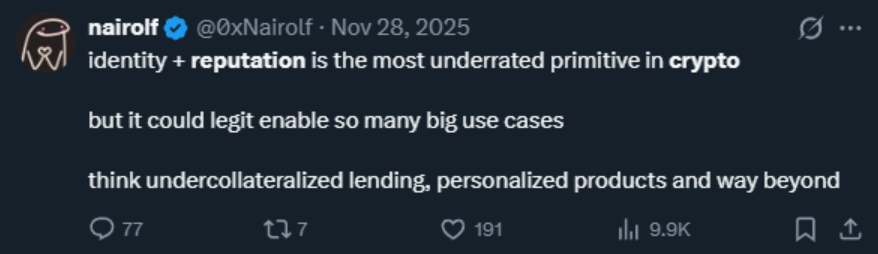
Reputation is the big, infallible filter that gates our binary friends at the door, no matter how sycophantically they want to agree with us in the replies.
It’s the thing allowing you to filter bad actors, scammers, impersonators ( @ ethos_network ). It’s what allows you to filter extractors, sybils, and misaligned investors ( @ legiondotcc ). It’s also the thing that allows you to find credible, genuine, and impactful voices in the space ( @ KaitoAI before the InfoFi craze).
And it’s going to become increasingly more important in the age of AI, so this will be a major, dominating topic in 2026.
ICO Renaissance
2017 was a crazy time. Fueled by a regulatory vacuum, Ethereum’s novel ERC-20 standard, and an incredible amount of greed, we saw thousands of projects raising money through the now-popular ICOs.
It was such an incredibly effective way of raising money that it quickly devolved into a lawless scam center and was then effectively stopped in its tracks by most major regulators.
Still, out of that era, major projects like BNB, TRX, and ADA were born that are still today part of the Top 10 biggest cryptocurrencies.
The ICO ban brought us to a bit of a dark age in crypto but also forced the industry through an experimental period on how token distributions and capital raises should work.
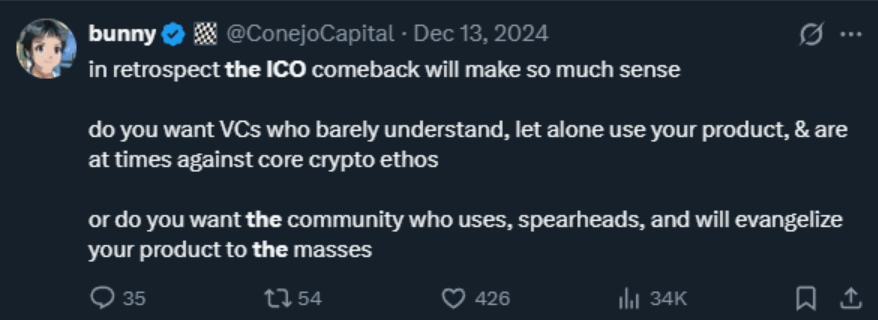
As a consequence, for distribution, we tried airdrops, which provided good initial distribution, was cheap, put your product in a lot of people’s minds, but eventually abused and squeezed dry by pure extractors and industrial farmers.
For fundraising, we tried the low-float, high-FDV VC model, which turned out very profitable for a certain cohort (insiders mostly), due to most of the price discovery happening before it hit the public, leaving retail rekt and holding the bag forever.
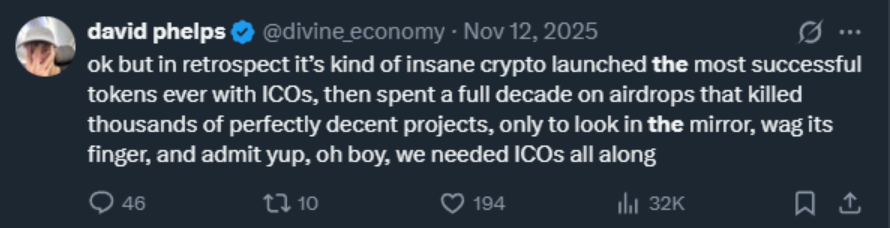
So, if 2025 was the year of regulatory clarity (which was the main setback against ICOs), it makes sense that 2026 will be the year of the ICO Renaissance. History is not the same, but it often rhymes, and we might see some of the major crypto players be born out of this new era of ICOs.
This is emerging as one of the most exciting sectors in the crypto space, a trend already evidenced by projects like @ legiondotcc (reputation-based ICOs), @ MetaDAOProject , and @ echodotxyz (recently acquired by Coinbase).
Crypto Neobanking
Neobanks disrupted the banking industry. Revolut is now one of the most valuable fintech firms in Europe, and Nubank one of the most valuable fintech firms in LATAM. And with an increasing digital-native investor base, it’s only sensible that Crypto Neobanking starts taking over, as it takes advantage of the same regulatory clarity benefiting ICOs.
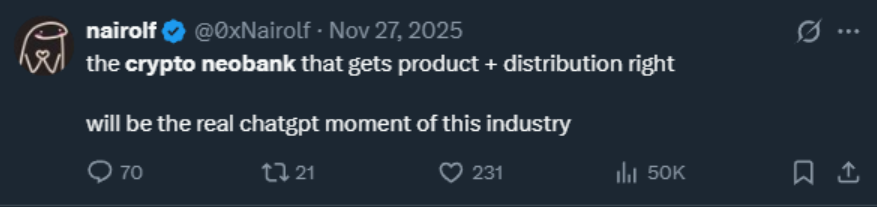
Self-custodial, yield-bearing accounts, and direct, instant, cross-border stablecoin payments, these are some of the features differentiating these from the traditional banking system.
And with the growth of stablecoins, and bigger, more democratic yield opportunities for its holders (no more savings accounts paying 0.2% APR), this too will start eating at the TradFi pie.
No clear winner here, and I’m not sure if a token will even benefit. Ultimately, stablecoins might be the real winner, but in my opinion, it will be one of the most important narratives of this year.
Disclaimer:
- This article is reprinted from [WazzCrypto]. All copyrights belong to the original author [WazzCrypto]. If there are objections to this reprint, please contact the Gate Learn team, and they will handle it promptly.
- Liability Disclaimer: The views and opinions expressed in this article are solely those of the author and do not constitute any investment advice.
- Translations of the article into other languages are done by the Gate Learn team. Unless mentioned, copying, distributing, or plagiarizing the translated articles is prohibited.
Related Articles

The Future of Cross-Chain Bridges: Full-Chain Interoperability Becomes Inevitable, Liquidity Bridges Will Decline

Solana Need L2s And Appchains?

Sui: How are users leveraging its speed, security, & scalability?

Navigating the Zero Knowledge Landscape

What is Tronscan and How Can You Use it in 2025?
